Top 10 Indian-Origin Websites in 2026 — And What Every Business Owner Can Learn From Them
Discover the top 10 Indian-origin websites dominating the internet in 2026 — including Flipkart, Cricbuzz, Meesho, IRCTC, Nykaa, and Zomato — and learn the powerful business, SEO, branding, and UX lessons behind their success. This deep-dive guide breaks down what every business owner can apply from India’s biggest digital brands to build a stronger online presence.
India has built some of the most remarkable internet companies in the world. From a railway ticketing platform handling millions of bookings a day to a fashion marketplace that redefined how Indian women shop, from a cricket scores website that beats global sports giants to a B2B marketplace that has digitised crores of Indian traders — Indian-origin websites are not just surviving in the global internet economy. They are dominating their categories.
This guide covers ten of India's most visited and most impactful homegrown websites in 2026 — platforms that were founded in India, built for Indian users, and scaled to serve hundreds of millions of visitors every month. More importantly, it extracts the specific, learnable lessons embedded in each platform's success — lessons that any Indian business owner can apply directly to their own website strategy today.
Traffic data in this guide is sourced from Semrush and Similarweb analytics tools as of early 2026 and should be treated as estimates. All brand names are the property of their respective owners.
The 10 Indian-Origin Websites Covered in This Guide
- 1. Flipkart.com — 194.31M monthly visits (Semrush, March 2026)
- 2. Cricbuzz.com — 229.19M monthly visits (Semrush, February 2026)
- 3. IRCTC.co.in — 51.72M monthly visits (Semrush, December 2025)
- 4. Meesho.com — 45.62M monthly visits (Semrush, March 2026)
- 5. Myntra.com — 55.07M monthly visits (Semrush, March 2026)
- 6. Zomato.com — Tens of millions monthly; 40.75% organic traffic share
- 7. Naukri.com — 17.18M monthly visits (Semrush, February 2026)
- 8. IndiaMART.com — 42.29M monthly visits (Semrush, March 2026)
- 9. Swiggy.com — 19M monthly visits (Semrush, 2026)
- 10. Nykaa.com — 10.27M monthly visits (Semrush, January 2026)
💡 Ownership Note: Flipkart is majority-owned by Walmart (72%) and Myntra is owned by Flipkart. Both are included in this guide because they were founded in India, built by Indian entrepreneurs for the Indian market, and represent uniquely Indian digital success stories — even though their current ownership structures involve foreign investors.
1. Cricbuzz.com — 229.19 Million Monthly Visits
Category: Sports and Cricket Media
Monthly Visits: 229.19 million (Semrush, February 2026 — during active cricket season)
Pages Per Visit: 12.44 — highest engagement of any Indian website
Audience: 82.12% male; core age group 25–34
Founded: 2004, acquired by Times Internet
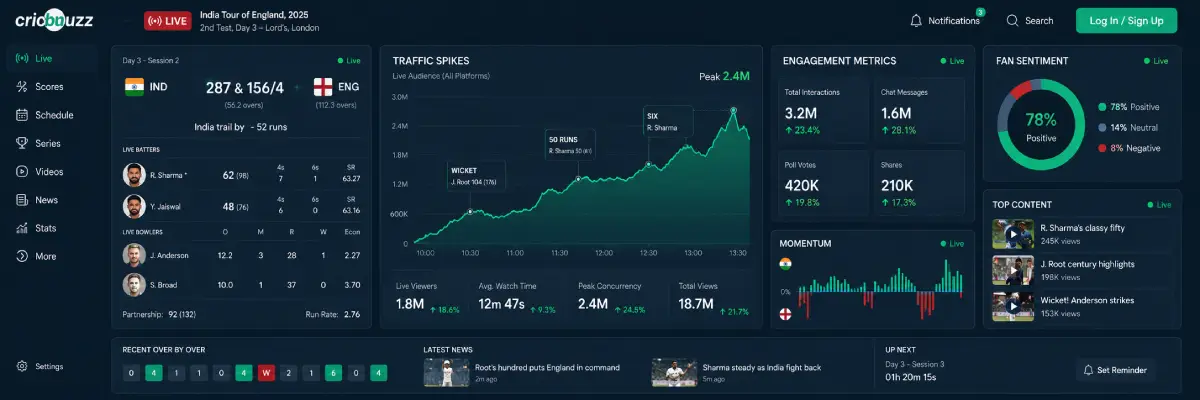
Cricbuzz is India's most engaged website by pages per visit — a staggering 12.44 pages per session that reflects an audience deeply invested in every ball, every wicket, and every scorecard update. Founded in 2004, it grew from a simple cricket scores website into India's dominant real-time cricket information platform, outperforming globally funded competitors like ESPNCricinfo in engagement metrics and mobile usage across the Indian market.
Cricbuzz's 229 million visits in February 2026 is not a stable monthly baseline — it is a cricket-season peak. The platform experiences dramatic traffic spikes during IPL, World Cup tournaments, and India bilateral series, demonstrating one of the most powerful content strategies available to any niche website: becoming the definitive real-time information source for something India is passionately obsessed with.
What Every Business Owner Can Learn From Cricbuzz
- 12.44 pages per visit is what deep content architecture looks like. Cricbuzz users do not visit one page and leave. They check the live scorecard, click through to ball-by-ball commentary, read the match report, check player stats, review the points table, and navigate to the next match. Each piece of content links naturally to the next relevant piece. Your website should mirror this: every page should have a clear, compelling reason to go somewhere else on your site. Related blog posts, internal links between service pages, and relevant CTAs that open new content threads keep visitors engaged far beyond a single page.
- Own one niche completely before expanding. Cricbuzz did not launch as a general sports website. It owned cricket — and only cricket — with obsessive depth before eventually expanding into other sports coverage. For any Indian business website, depth in one category produces far stronger SEO and audience loyalty than shallow coverage across many. If you are a digital agency in Mangaluru, owning "digital marketing for coastal Karnataka businesses" before trying to rank for "digital marketing in India" is the same principle.
- Real-time, time-sensitive content drives extraordinary repeat traffic. Cricbuzz's traffic spikes during live matches because millions of users refresh the page every few minutes for live updates. The principle — content that is uniquely valuable at a specific moment drives habitual return visits — applies beyond cricket. A restaurant that posts "today's specials" every morning, a real estate developer that posts fresh unit availability daily, or a retailer that runs time-limited flash offers creates the same return-visit habit in their audience.
- Mobile-first UX is the reason Cricbuzz won over ESPN in India. Cricbuzz's clean, fast, mobile-optimised interface — designed from the ground up for mid-range Indian smartphones — beat a globally funded competitor with more resources simply by loading faster and navigating more intuitively on the devices most Indian users actually have. Speed and simplicity on mobile is a competitive advantage in any Indian digital category.
2. Flipkart.com — 194.31 Million Monthly Visits
Category: E-Commerce
Monthly Visits: 194.31 million (Semrush, March 2026)
Pages Per Visit: 8.55 (Meesho leads retail at this metric; Flipkart high single digits)
Founded: 2007 by Sachin Bansal and Binny Bansal, Bengaluru
Flipkart started as an online bookstore launched from a Bengaluru apartment by two IIT Delhi graduates and former Amazon employees. It grew to become India's largest homegrown e-commerce platform — and while Walmart acquired a 72% stake in 2018 for $16 billion, Flipkart remains the most deeply Indian e-commerce experience available, understanding local payment preferences, regional languages, festival buying patterns, and the specific trust and UX requirements of Indian consumers better than any global competitor.
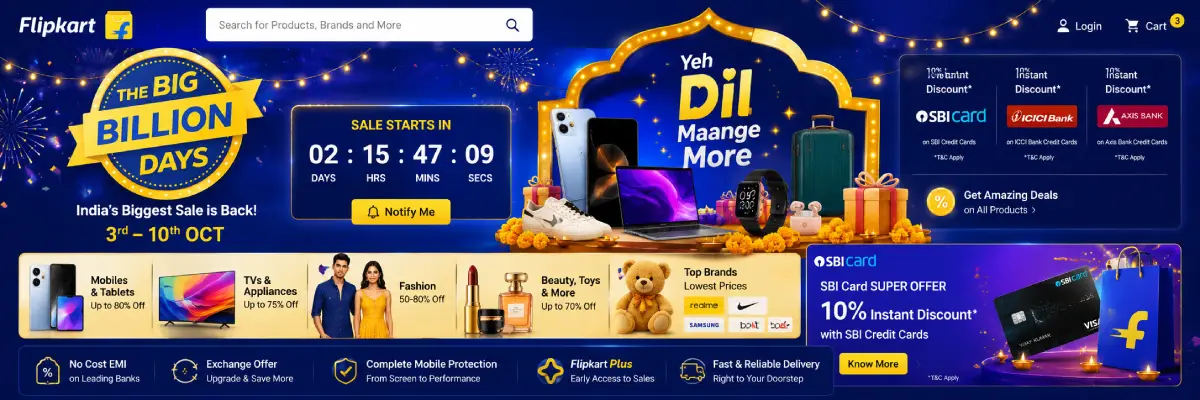
Flipkart's Big Billion Days sale — a multi-day mega event held every October — is one of the most anticipated digital events in India's retail calendar. Weeks of build-up through every digital channel drive extraordinary traffic spikes, with billions in GMV transacted in days. Its recent launches — Flipkart Minutes (quick commerce), Shopsy (social commerce), and Flipkart Live (video commerce) — show a platform constantly adapting to where Indian digital commerce is heading.
What Every Business Owner Can Learn From Flipkart
- Create sale events — not just discounts. Flipkart's Big Billion Days is not a price reduction. It is a cultural event with advance hype, countdown timers, exclusive launches, bank offer partnerships, and influencer build-up. The distinction matters enormously. A discount that is always available creates no urgency. A sale event with a defined window, advance teasing, and exclusive products creates genuine excitement and drives behaviour. Every Indian business can apply this at its own scale — a seasonal sale with 3 weeks of advance build-up will dramatically outperform the same discount offered quietly on a website.
- Design for India's real user — not your ideal user. Flipkart's UX is built for the mobile-first, mid-range smartphone user from Tier 2 India as much as for the tech-savvy Bengaluru shopper. Clean, fast, direct navigation with visible filters and clear category organisation. Most business owners design websites for themselves — educated, smartphone-comfortable urban professionals. Study your analytics and design for the actual majority of your visitors.
- Trust signals at the point of purchase convert hesitant buyers. Flipkart places return policies, delivery dates, seller ratings, and buyer reviews prominently on every product page — because Indian consumers need reassurance precisely when they are deciding to buy. For any Indian business website, trust signals — testimonials, guarantees, certifications, easy return policies — must be visible where visitors are making their decision, not buried on a separate page.
- Quick commerce and social commerce are India's next growth frontiers. Flipkart's investments in Minutes and Shopsy reflect where Indian consumer behaviour is heading — faster delivery expectations and discovery through social feeds. Businesses that understand these trends and position their digital presence accordingly are building a structural advantage over those that do not.
3. Myntra.com — 55.07 Million Monthly Visits
Category: Fashion E-Commerce
Monthly Visits: 55.07 million (Semrush, March 2026)
Average Session Duration: 7 minutes 49 seconds
Founded: 2007; acquired by Flipkart in 2014
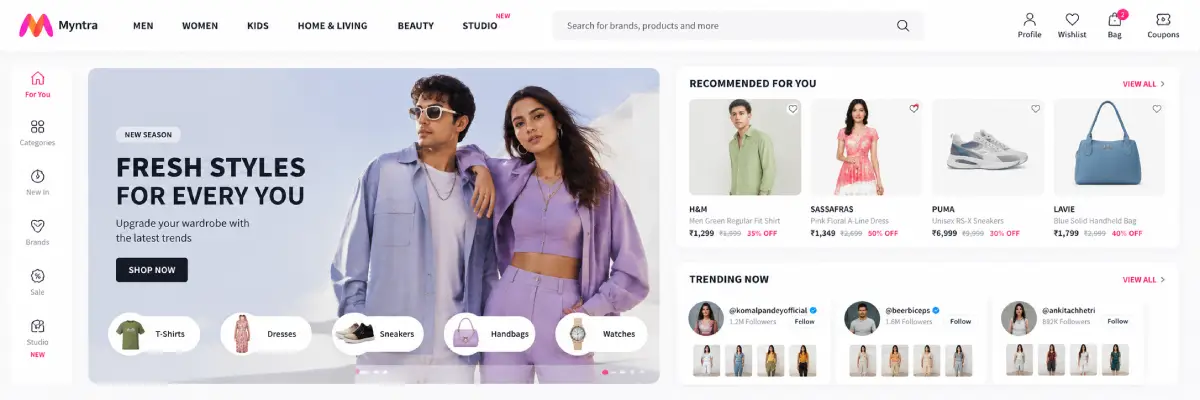
Myntra is India's dominant online fashion and lifestyle destination. What began as a B2B personalised gifting website in 2007 pivoted into fashion e-commerce and was acquired by Flipkart in 2014. Today it is the first stop for fashion discovery among India's urban, style-conscious consumers — with a product catalogue spanning hundreds of brands, a deeply personalised browsing experience, and one of India's most sophisticated visual commerce interfaces.
Myntra's content strategy — through its Studio feature, fashion editorial content, trend reports, and influencer collaborations — has turned a transactional shopping platform into a fashion inspiration destination. Its End of Reason Sale (EORS) is one of the largest fashion sale events in India, rivalling Big Billion Days in its category for consumer anticipation and media coverage.
What Every Business Owner Can Learn From Myntra
- Turn your product catalogue into a content destination. Myntra Studio — editorial content, trend guides, outfit inspiration, and influencer looks — keeps users on the platform far longer than a pure transactional catalogue. For any e-commerce or product business, content that inspires and educates rather than just listing products reduces bounce rate, increases session depth, and converts browsers into buyers at a higher rate.
- Personalisation is the most powerful retention tool in e-commerce. Myntra's homepage, product recommendations, size suggestions, and notification strategy are all personalised based on browsing and purchase history. The more it learns about a user, the more relevant it becomes — and the harder it becomes to replace. For any Indian e-commerce business, even basic personalisation — "You might also like," "Complete the look," "Back in your size" — meaningfully improves conversion and repeat purchase rates.
- Visual quality is a non-negotiable investment for fashion and lifestyle brands. Myntra invests heavily in product photography — multiple angles, zoom functionality, model shots on diverse body types, flat-lay options. The result is a visual experience that builds product confidence and reduces return rates. For any business selling physical products online, high-quality product photography is not a nice-to-have. It is a direct driver of conversion rate and customer satisfaction.
- Your sale event needs a name and an identity. Myntra's End of Reason Sale has its own acronym (EORS), its own visual identity, its own advance countdown, and its own annual anticipation cycle. Giving your sale a memorable name and consistent identity — rather than running anonymous "20% off" promotions — builds cumulative brand equity across every edition.
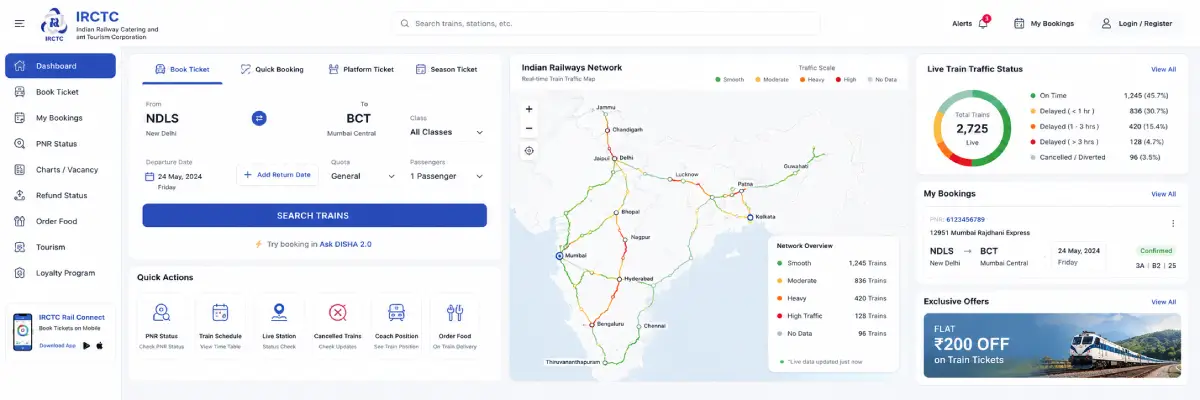
4. IRCTC.co.in — 51.72 Million Monthly Visits
Category: Government / Railway Ticketing
Monthly Visits: 51.72 million (Semrush, December 2025)
Average Session Duration: 9 minutes 37 seconds
Direct Traffic Share: 65.38%
Registered Users: 66 million; 7.31 lakh daily tickets booked (as of December 2023)
IRCTC is the most visited government website in India and one of the highest-transaction-volume websites in the country. Established in 1999 and accorded Navratna status by the Government of India in March 2025, it handles online booking for India's 13,000+ daily train services — an infrastructure challenge of extraordinary complexity delivered through a single website used by tens of millions of Indians every month.
IRCTC's 65% direct traffic share is the most telling metric on this entire list. Nearly two-thirds of its visitors do not find it through Google or any other referral channel. They go directly — because it is embedded in their routine. This is the result of being genuinely indispensable: a platform that handles something so important, so frequently, that users have internalised it as a destination rather than a search result.
What Every Business Owner Can Learn From IRCTC
- Direct traffic is the ultimate measure of brand loyalty — and it is built through genuine utility. IRCTC's 65% direct traffic did not come from brand advertising. It came from being genuinely, repeatedly useful to millions of people for something that matters. The question for any business: what is your version of "I need to book a train ticket"? What problem do you solve so consistently and reliably that customers think of you directly without needing to search? Build that utility and direct traffic follows.
- A nearly 10-minute session duration reflects a website earning its visit. IRCTC users stay for nearly 10 minutes because they are completing a complex, multi-step task — searching, comparing, selecting, booking, paying. Your website's session duration should be benchmarked against the complexity of what you are asking visitors to accomplish. If visitors are leaving in 90 seconds on a page that requires 5 minutes of consideration, the UX is creating friction that is costing you conversions.
- Reliability and uptime are brand values, not just IT metrics. IRCTC handles extraordinary traffic spikes — when Tatkal booking windows open at 10 am, millions of users hit the website simultaneously. The platform's engineering investment in handling this load is a business decision, not just a technical one. For any Indian e-commerce or booking website, especially during sale events or promotion periods, server capacity and uptime directly affect revenue and reputation.
- Loyalty programmes on transactional platforms extend customer lifetime value. IRCTC's Shubh Yatra loyalty programme — offering discounts to frequent travellers through an upfront subscription — converts occasional users into committed regular customers. The same principle applies to any service business with repeat purchase potential: a loyalty or subscription mechanism that rewards frequency creates a defensible customer relationship.
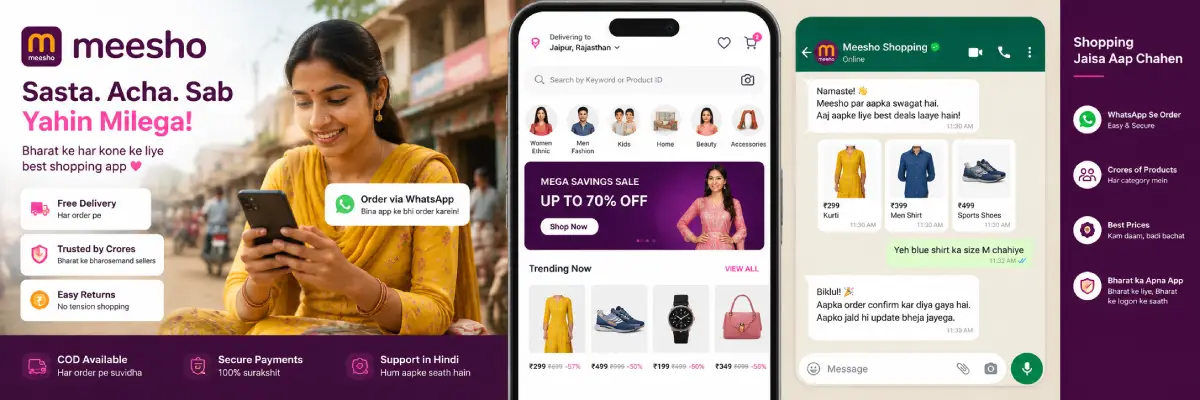
5. Meesho.com — 45.62 Million Monthly Visits
Category: Social Commerce / E-Commerce Marketplace
Monthly Visits: 45.62 million (Semrush, March 2026)
Average Session Duration: 11 minutes 42 seconds
Direct Traffic Share: 80.79%
Bounce Rate: 39.24% — lowest in Indian retail
Founded: 2015 by Vidit Aatrey and Sanjeev Barnwal, IIT Delhi
Meesho is one of the most remarkable growth stories in Indian internet history. Founded in 2015 to enable home-based entrepreneurs — primarily women — to resell products through WhatsApp and Facebook without holding inventory, it evolved into a full e-commerce marketplace with a singular focus: serving the Indian consumer that Flipkart and Amazon had ignored — smaller cities, tighter budgets, vernacular language speakers.
Meesho's engagement metrics are extraordinary. Its 11 minute 42 second average session duration, 39.24% bounce rate — the lowest in Indian retail — and 80.79% direct traffic share collectively describe a platform that its users are deeply loyal to, return to habitually, and engage with at a depth that far exceeds its transactional competitors. Its zero-commission model for sellers disrupted India's marketplace economics and drove a wave of small seller adoption from towns and cities that had never participated in online commerce before.
What Every Business Owner Can Learn From Meesho
- 80.79% direct traffic and 39.24% bounce rate is what brand loyalty looks like in data. Meesho's users do not need Google to find it — they return directly because the platform delivers consistent value for their specific shopping needs. The two metrics are related: a low bounce rate means users find what they came for, and that satisfaction drives the direct return visits that build direct traffic over time. Build a website that consistently delivers what your specific audience comes for and both metrics improve together.
- Tier 2 and Tier 3 India is the largest and fastest-growing digital market in the country. Meesho's success is a story about serving the India that premium platforms ignored. If your business currently serves only metro cities and English-speaking customers, you are addressing a fraction of India's online population. Regional language content, Tier 2–appropriate pricing, and vernacular UX are not niche strategies — they are access to the majority market.
- Social commerce converts through trusted personal recommendations. Meesho was built on the insight that Indian consumers trust recommendations from people they know far more than advertising. Sharing products through WhatsApp and Facebook — effectively a peer-to-peer referral model — was its original distribution engine. Build social sharing, WhatsApp forwarding, and referral mechanisms into your product pages and your checkout flow. Every share is a free, trusted endorsement to a new potential customer.
- An 11-minute average session is built through product depth and browsing UX. Meesho keeps users browsing through an affordable and extensive product catalogue, personalised discovery feeds, and a homepage designed for exploration rather than pure transaction. For any e-commerce business, the browsing experience — not just the conversion funnel — drives basket size, session depth, and return visits.
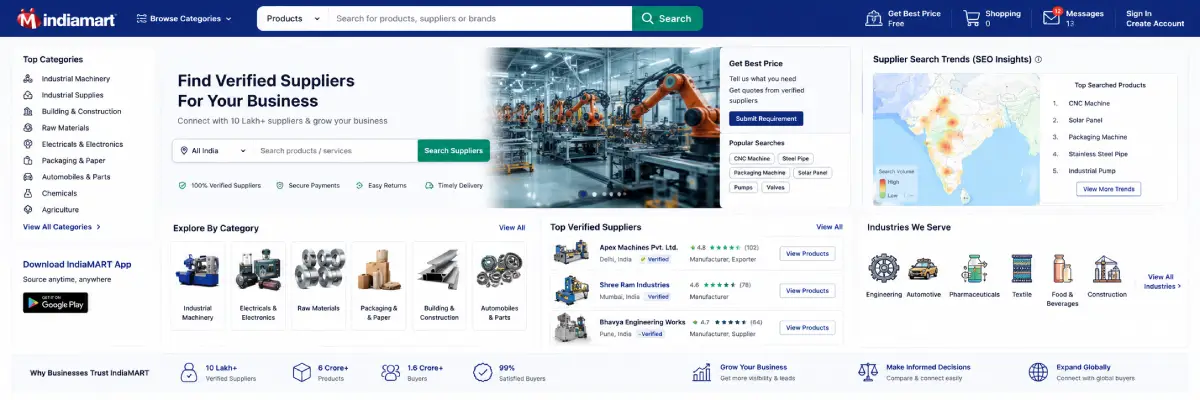
6. IndiaMART.com — 42.29 Million Monthly Visits
Category: B2B Marketplace
Monthly Visits: 42.29 million (Semrush, March 2026)
Average Session Duration: 8 minutes 52 seconds
Organic Traffic Share: 57.85% — the highest SEO dependency of any platform in this list
Founded: 1999 by Dinesh Agarwal, Aligarh
IndiaMART is India's largest B2B marketplace and one of the oldest surviving Indian internet businesses, founded in 1999 — predating most of the platforms on this list. It connects buyers with suppliers across every product category imaginable, from industrial machinery and raw materials to packaged food and handicrafts. With over 7.5 million suppliers and 150 million+ products listed, IndiaMART has digitised a massive segment of India's informal trade and manufacturing economy.
IndiaMART's 57.85% organic traffic share is the highest of any platform in this guide — meaning the majority of its 42 million monthly visitors arrive through Google searches for specific products and suppliers. This is programmatic SEO at extraordinary scale: millions of product and supplier pages, each targeting a specific search query from a business buyer looking for exactly what that page offers.
What Every Business Owner Can Learn From IndiaMART
- 57.85% organic traffic is the result of programmatic SEO done right. IndiaMART generates millions of unique, indexable pages — one for every product category, supplier, and location combination. A buyer searching "stainless steel utensils manufacturer in Rajkot" finds an IndiaMART page built specifically for that query. Any business with a scalable content structure — service area pages, product category pages, location-specific landing pages, or FAQ pages — can apply programmatic SEO principles to dramatically expand its Google footprint and organic traffic share.
- Being first in a category compounds over decades. IndiaMART launched India's B2B marketplace before the concept had a name. Its 25+ years of SEO authority — reflected in nearly 19,000 referring domains — is an asset that no competitor can replicate quickly. The lesson is not that you should have started 25 years ago. It is that starting now is the only way to have the compounded authority of a 5-year-old SEO programme in five years. Every month you delay is a month of compounding you will never get back.
- B2B buyers search differently — and targeting them requires different content. IndiaMART's SEO strategy reflects the reality that B2B buyers search with specific, technical, product-level queries: "stainless steel wire mesh manufacturer India," "wholesale cotton fabric Surat price," "CNC machining parts Pune supplier." If your business serves other businesses, your website content needs to be structured around these specific, intent-rich queries rather than the generic category terms that B2C brands target.
- Trust infrastructure for high-value B2B transactions must be built into the platform design. IndiaMART invests in seller verification, Trust Seal programmes, and transaction protection features because B2B buyers making lakhs-worth purchases need confidence that suppliers are legitimate. Any business handling significant B2B transactions online needs visible trust infrastructure — verified credentials, physical address, registration details, and a clear escalation process for disputes — to convert high-value prospects.
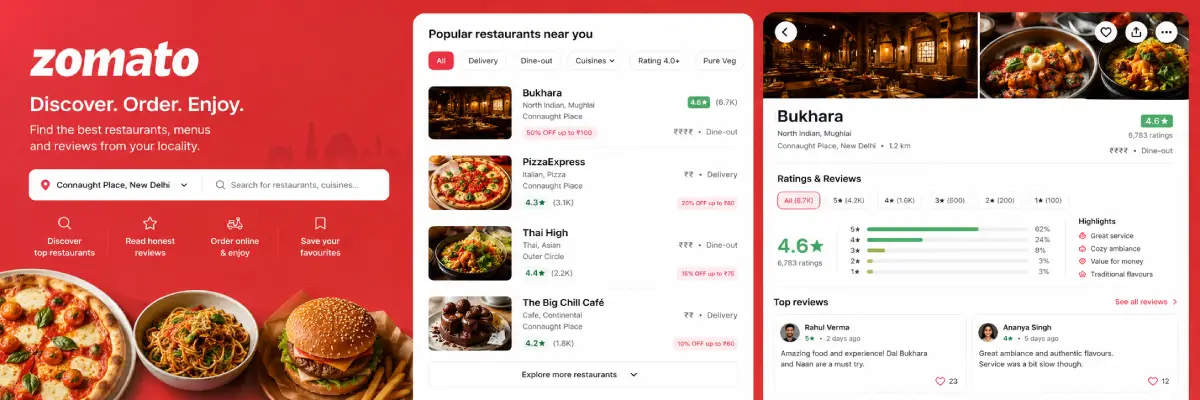
7. Zomato.com — India's Food Discovery and Delivery Leader
Category: Food Delivery and Restaurant Discovery
Monthly Visits: Tens of millions monthly
Organic Traffic Share: 40.75% — strong SEO foundation
Direct Traffic Share: 49.79%
Founded: 2008 by Deepinder Goyal and Pankaj Chaddah, IIT Delhi
Zomato launched in 2008 as a restaurant menu aggregator — a simple website that digitised physical restaurant menus so users could browse them online. That insight — that people want to discover and evaluate food options before committing — was the seed of what became one of India's most valuable internet companies, listed on the stock exchange with a market capitalisation in the tens of thousands of crores.
Zomato's evolution from menu aggregator to food delivery to quick commerce (through Blinkit, acquired in 2022) reflects a platform that has consistently anticipated and moved ahead of Indian consumer behaviour. Its restaurant listing pages — with menus, photos, reviews, ratings, and location — are among the most visited content pages on the Indian internet, indexed by Google for millions of restaurant-related searches every day.
What Every Business Owner Can Learn From Zomato
- User-generated content at scale is your most powerful SEO asset. Zomato's millions of restaurant pages are enriched with user reviews, photos, and ratings contributed by customers over years. This UGC makes each page more comprehensive, more credible, and more search-engine-friendly than any editorial content Zomato could produce internally. For any business, building mechanisms for customers to leave reviews, share photos, and contribute content creates a self-compounding SEO asset that improves with every new customer interaction.
- The combination of discovery and transaction in one experience is a powerful moat. Zomato did not just build an ordering system. It built the discovery experience that precedes ordering — browsing cuisines, comparing restaurants, reading reviews — and then made the ordering step the natural next action within the same interface. For any Indian business, reducing the distance between discovery and purchase — making the step from "I found this" to "I bought this" as short as possible — is one of the highest-value UX investments available.
- A 40.75% organic traffic share means Zomato's SEO is a significant competitive moat. If Zomato suddenly lost its search rankings, it would lose nearly half its traffic overnight. That dependency is also a strength — millions of new users who have never heard of Zomato discover it every month through Google searches for specific restaurants, cuisines, and areas. Building your website's organic search presence is building a traffic source that compounds independently of your paid marketing budget.
- Diversification into adjacent categories extends platform value and reduces churn. Zomato's move into quick commerce (Blinkit), business supplies (Hyperpure), and dining-out (Zomato Gold) means its relationship with customers extends far beyond a single use case. For service businesses especially, identifying adjacent services that your existing customers already need — and bringing those into your platform — increases customer lifetime value and reduces the risk of losing customers to a competitor who serves more of their needs.
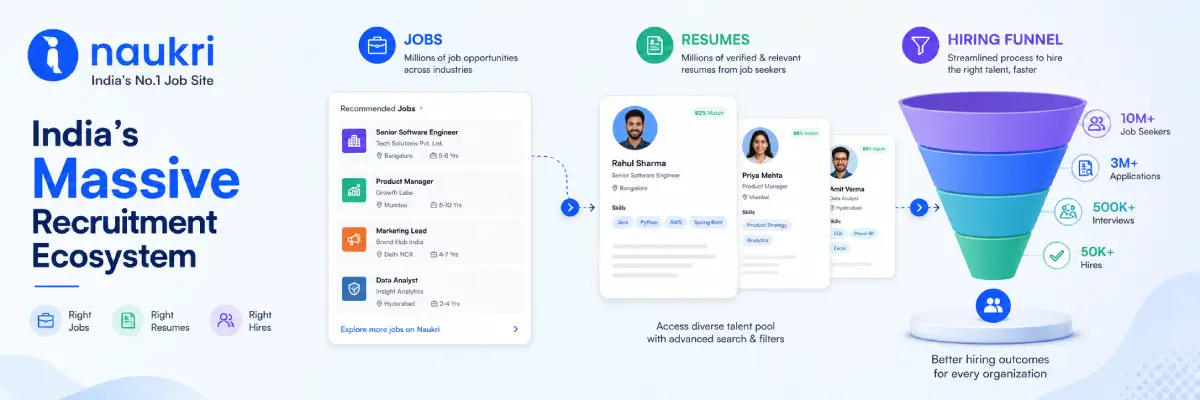
8. Naukri.com — 17.18 Million Monthly Visits
Category: Jobs and Employment
Monthly Visits: 17.18 million (Semrush, February 2026)
Founded: 1997 by Sanjeev Bikhchandani, Noida — one of India's oldest surviving internet businesses
Naukri.com launched in 1997 — making it one of the oldest Indian internet businesses still operating at market leadership. The fact that a 27-year-old website remains the dominant player in India's online recruitment industry — fending off LinkedIn, Indeed, Shine, Monster, and multiple well-funded challengers — makes it one of the most instructive long-term digital brand studies available.
Naukri's dominance is built on network effects that compound over time: more job seekers make it more attractive to employers, more employer listings make it more useful to job seekers, and the cycle reinforces itself every day. Its CV database — containing tens of millions of profiles accumulated over nearly three decades — is a proprietary competitive moat that no new entrant can replicate regardless of funding or marketing spend.
What Every Business Owner Can Learn From Naukri
- Network effects are the most durable competitive moat in digital business. Naukri is more valuable today than it was five years ago — not because it has spent more on marketing, but because its network has grown larger and more comprehensive. Every new job seeker who registers makes it marginally more valuable for every employer. Every new job listing makes it marginally more valuable for every job seeker. For any business that brings buyers and sellers, service providers and clients, or any two-sided audience together — building a network effect is your highest-priority strategic goal.
- SEO-driven programmatic content at scale is an unassailable traffic strategy. Naukri has millions of indexable pages — every job, every company, every city, every job function and city combination. Each targets a specific search query with high intent. A business owner in Bengaluru looking for a React developer searches "React developer jobs Bengaluru" and finds a Naukri page. This programmatic approach to content and SEO is not limited to job boards — any Indian business with scalable content can build the same traffic engine at its own level.
- A 27-year-old brand proves that consistency compounds into authority. Naukri's domain authority, backlink profile, and brand recognition are the result of 27 years of consistent online presence, content, and service delivery. The most important investment any Indian business can make in its digital presence is committing to it long-term — consistent blogging, consistent SEO, consistent social media, consistent Google Business management. The compounding effects are not visible in month three. They are visible in year three and year five.
- Email and notification-based retention is a masterclass in permission marketing. Naukri's job alert system delivers personalised, relevant notifications to millions of registered candidates by email and SMS — a direct line to its most engaged audience that bypasses Google, social media algorithms, and every other intermediary. Building your own opt-in database — email subscribers, WhatsApp broadcast members, push notification subscribers — creates a direct marketing channel that you own and control, immune to platform algorithm changes.
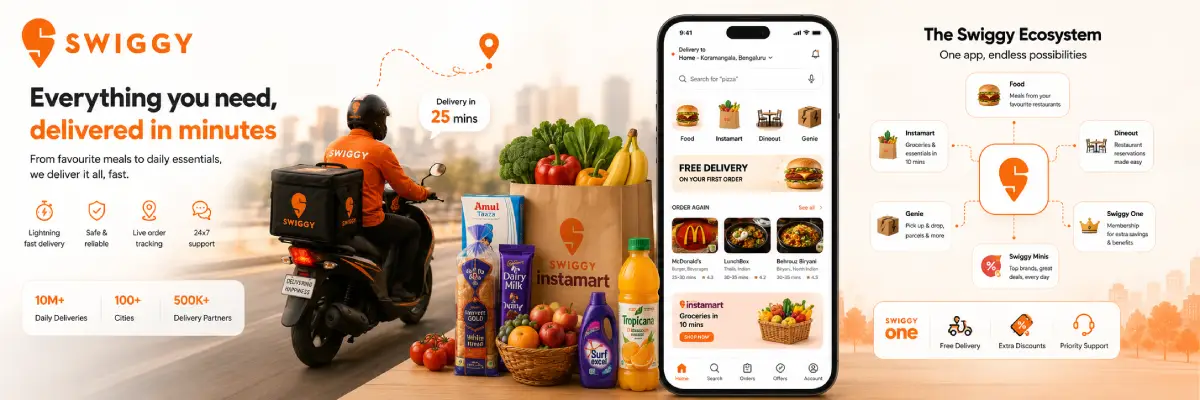
9. Swiggy.com — 19 Million Monthly Visits
Category: Food Delivery / Quick Commerce
Monthly Visits: ~19 million (Semrush, 2026)
Direct Traffic Share: 56.87%
Founded: 2014 by Sriharsha Majety, Nandan Reddy, and Rahul Jaimini, Bengaluru
Swiggy launched in Bengaluru in 2014 and within a decade became one of India's most downloaded apps and most recognised consumer brands. Its expansion from food delivery into Instamart (quick commerce for groceries), Genie (instant package delivery), Dineout (restaurant reservations), and Swiggy One (membership programme) reflects the same platform extension strategy as Zomato — building multiple high-frequency use cases on a single consumer relationship.
Swiggy's 56.87% direct traffic share is a testament to the strength of its mobile app ecosystem — the vast majority of Swiggy transactions happen on the app, with the website serving primarily as a discovery and account management interface. This app-first model is a significant strategic insight for any Indian consumer business.
What Every Business Owner Can Learn From Swiggy
- Hyper-convenience is the most powerful customer acquisition strategy in urban India. Swiggy's foundational insight — that urban Indians will pay a premium for not having to leave home to get food — unlocked a market that traditional food delivery had never cracked. The convenience premium is real across Indian consumer categories: businesses that remove friction, reduce wait times, and deliver directly to the customer consistently command higher prices and stronger loyalty than those that require the customer to come to them.
- A membership programme converts occasional users into loyal advocates. Swiggy One — offering free deliveries, exclusive offers, and priority support for a monthly or annual fee — transforms transactional customers into committed platform loyalists. The economics of a membership programme work because even at a reduced per-transaction margin, the guaranteed repeat volume from members dramatically improves lifetime value. For any Indian service business with repeat purchase potential, a subscription or membership tier is among the highest-ROI commercial structures available.
- Bundling multiple services on one platform increases switching cost. A Swiggy user who books restaurant reservations through Dineout, orders groceries through Instamart, and occasionally uses Genie for deliveries is far harder to lose to a competitor than a user who only orders food. Every additional service you bundle on your platform increases the switching cost for your customers — the more jobs they hire you for, the fewer reasons they have to go elsewhere.
- Brand recall through consistent visual identity is a marketing multiplier. Swiggy's orange — its distinctive brand colour — is immediately recognisable across its app icon, delivery bag, and all marketing materials. In India's cluttered digital marketplace, a strong, consistent visual identity reduces the cognitive effort required for customers to recognise and choose you. Invest in a professional brand identity and apply it consistently across every touchpoint.
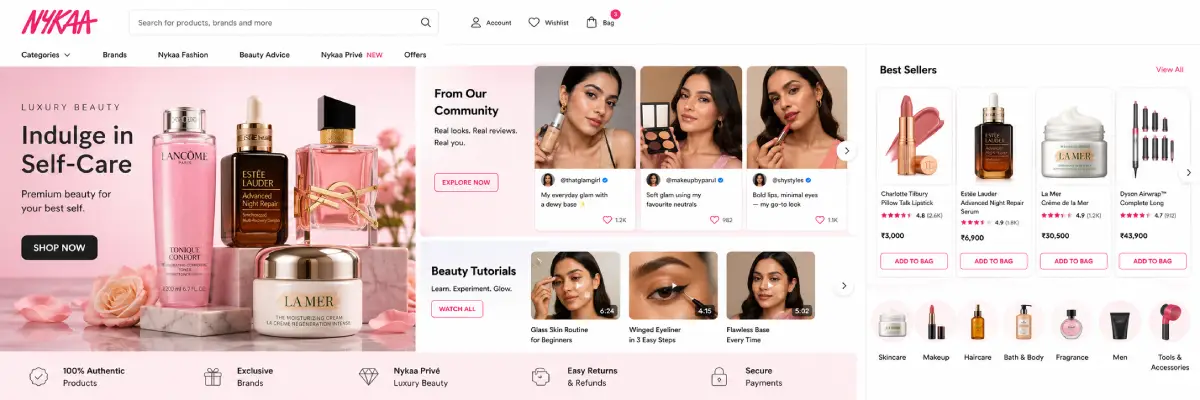
10. Nykaa.com — 10.27 Million Monthly Visits
Category: Beauty and Lifestyle E-Commerce
Monthly Visits: 10.27 million (Semrush, January 2026)
Average Session Duration: 6 minutes 20 seconds
Direct Traffic Share: 44.01%
Founded: 2012 by Falguni Nayar, Mumbai
Nykaa is one of India's most celebrated entrepreneurial success stories. Founded in 2012 by Falguni Nayar — a former investment banker who started the company at 49 — Nykaa became India's dominant beauty e-commerce platform and the first Indian unicorn founded by a woman to list on the stock exchange. Its IPO in November 2021 at a valuation of approximately ₹1 lakh crore was one of the most celebrated listings in India's startup history.
Nykaa is not just a shopping website. It is a beauty content platform, an influencer marketing ecosystem, a brand incubator for Indian beauty brands, and a retail destination — with both online and offline stores across India. Its website blends editorial beauty content, product reviews, tutorial videos, and shopping in a seamless experience that keeps beauty consumers deeply engaged.
What Every Business Owner Can Learn From Nykaa
- Content marketing and commerce integrated in one experience is the most powerful D2C model. Nykaa Beauty Book — its editorial magazine-style content covering skincare routines, makeup tutorials, ingredient explainers, and trend reports — is not separate from the shopping experience. Every article links to relevant products. Every tutorial features purchasable items. Every trend report ends with a shop-the-look option. This content-to-commerce integration converts inspiration into transaction more effectively than any advertising campaign. Any Indian e-commerce business can implement a version of this — a blog that educates customers about your product category and links naturally to relevant products in your catalogue.
- Category authority commands premium pricing and brand loyalty. Nykaa does not compete on price. It competes on curation, expertise, and trust. Its status as India's authoritative beauty destination means customers pay a slight premium to buy from it over generic marketplaces, confident they are getting authentic products with genuine expert backing. Building category authority through content, certification, partnerships, and expert positioning enables premium pricing in almost any Indian market.
- A physical retail presence reinforces an online brand. Nykaa's decision to open physical stores — Nykaa Beauty stores in malls across India — strengthened the online brand rather than competing with it. Customers who experienced the brand physically became more confident, higher-spending online customers. For any Indian D2C brand at scale, a thoughtful omnichannel presence amplifies both channels rather than cannibalising either.
- It is never too late — or too early — to build a category-defining Indian digital brand. Falguni Nayar founded Nykaa at 49 with no prior startup or tech experience. The lesson is not specific to entrepreneurship. It is that the gap between what exists and what Indian consumers actually need remains large in many categories — and the businesses that identify and serve those gaps with genuine expertise and digital-first execution can build extraordinary positions. What gap exists in your market that no one is serving well?
The 10 Universal Lessons From India's Top Indian-Origin Websites
- 1. Direct traffic is the measure of brand loyalty. IRCTC's 65%, Meesho's 81%, and Swiggy's 57% direct traffic shares are all built through genuine, repeated utility. Build something indispensable for your specific audience and direct traffic follows.
- 2. Engagement depth beats raw traffic volume. Cricbuzz's 12.44 pages per visit and Meesho's 11:42 session duration are built through content depth, internal linking, and UX that rewards continued exploration. Design your website for depth, not just arrival.
- 3. Programmatic SEO at scale builds organic traffic moats. IndiaMART's 57.85% organic traffic and Naukri's decades of indexed content prove that structured, scaled content production compounds into traffic advantages that no advertising budget can replicate.
- 4. Low bounce rate is earned by delivering exactly what visitors came for. Meesho's 39.24% bounce rate is the lowest in Indian retail. It is achieved by showing price-sensitive Tier 2 buyers exactly the affordable, varied product selection they arrived expecting.
- 5. Sale events with names and identities outperform anonymous discounts. Big Billion Days, EORS, and Zomato Gold are not promotions. They are events with identity, anticipation, and cultural presence. Give your offers a name.
- 6. Social and peer sharing is India's most trusted distribution channel. Meesho was built on WhatsApp sharing. Zomato reviews are built on peer recommendations. Trust between people you know moves product in India more effectively than any advertising.
- 7. Niche depth before category breadth builds unassailable market positions. Cricbuzz owned cricket, Nykaa owned beauty, Naukri owned recruitment. Each became the definitive destination in their category before expanding. Own your niche first.
- 8. Network effects compound silently until they become unassailable. Naukri's 27-year moat and IndiaMART's 25-year supplier network are the result of network effects compounding daily. Identify the network effect available in your business and invest in it deliberately.
- 9. Content integrated with commerce converts at dramatically higher rates. Nykaa's Beauty Book, Myntra Studio, and Zomato's review ecosystem all prove that content that educates and inspires — linked directly to relevant products or services — converts better than any pure product catalogue.
- 10. Regional language and Tier 2 India is the majority market — and most businesses are ignoring it. Meesho's success is entirely built on this insight. The majority of India's online population is not English-speaking, metro-dwelling, and tech-sophisticated. Businesses that build for this majority rather than the minority at the top of the pyramid are addressing India's real growth opportunity.
Frequently Asked Questions
What is the most visited Indian-origin website in 2026?
By monthly traffic volume, Cricbuzz.com is among the highest-traffic Indian-origin websites during cricket season, recording 229.19 million visits in February 2026 according to Semrush data. However, this figure is heavily influenced by active cricket tournament periods. Flipkart.com with 194.31 million monthly visits is the most consistently high-traffic Indian-origin commercial website. Both Cricbuzz and Flipkart sit alongside other major Indian platforms including Myntra, IRCTC, Meesho, and IndiaMART in India's most-visited homegrown website list.
Is Flipkart still an Indian company?
Flipkart was founded in India in 2007 by Sachin Bansal and Binny Bansal, both IIT Delhi graduates. It is included in this guide as an Indian-origin website because of its Indian founding, Indian focus, and the fact that it represents one of India's most significant digital success stories. However, it is important to note that Walmart acquired a 72% controlling stake in Flipkart in 2018 for $16 billion, making it technically majority foreign-owned at the corporate level. Myntra, which is a Flipkart subsidiary, shares this ownership context.
Which Indian website has the best SEO strategy?
IndiaMART.com stands out for having the highest organic traffic dependency of any platform in this list — 57.85% of its 42 million monthly visits arrive through Google organic search. Its programmatic SEO approach — millions of unique, well-structured product and supplier pages targeting specific search queries — represents one of the most sophisticated and scalable organic search strategies in Indian e-commerce. Naukri.com's decades-long SEO compounding, with 18,910 referring domains and millions of indexed job listing pages, is equally impressive from a long-term authority perspective.
What can a small Indian business learn from these websites?
The most immediately actionable lessons for small Indian businesses are: build and fully optimise your Google Business Profile (Zomato and IndiaMART lesson on local search visibility); add a WhatsApp button to your website and build a broadcast list (Meesho and Swiggy lesson on direct communication); create a sale event with a name and advance build-up rather than anonymous discounts (Flipkart and Myntra lesson); write blog content that answers the specific questions your customers search on Google (IndiaMART and Naukri lesson on programmatic SEO); and invest in mobile speed — test your website on a mid-range Android phone today (Cricbuzz and IRCTC lesson on India's real user).
Why does Cricbuzz have such high traffic despite being a niche sports website?
Cricbuzz has exceptionally high traffic — particularly during tournament periods — because cricket is not a niche interest in India. It is arguably the single most emotionally engaging topic for the largest segment of the Indian internet-using population. Cricbuzz identified this and built the most comprehensive, fastest, most mobile-friendly cricket information experience available — then optimised it relentlessly for the specific way Indian cricket fans consume information: live scores, ball-by-ball updates, player stats, and match commentary, all accessible on mid-range smartphones with variable internet connectivity. The lesson is not "build a cricket website." It is "build the best possible digital experience for the thing your specific audience cares about most deeply."
How NammoraX Can Help Your Business Apply These Lessons
At NammoraX, we build websites and digital strategies that apply the exact principles demonstrated by India's top-performing homegrown websites — mobile-first design, fast loading, conversion-optimised UX, SEO that compounds, WhatsApp integration, content that drives engagement, and Google Business management — for businesses across India and the Middle East.
Whether you are building your first website, redesigning an underperforming one, or looking to grow your digital presence with a strategy informed by how India's best digital platforms actually succeed — NammoraX brings the expertise to make it happen for your business.
- Mobile-first website design and development built for India's real users
- Google Business Profile setup, optimisation, and ongoing management
- WhatsApp Business integration, catalogue setup, and broadcast marketing
- SEO strategy — local, programmatic, and technical — for Indian search behaviour
- Content marketing that educates, ranks, and converts
- Instagram and YouTube content strategy and Reels production
- Facebook and Instagram paid advertising with precise Indian audience targeting
- E-commerce development — Shopify, WooCommerce, and custom platforms
- Monthly performance reporting — traffic, conversions, rankings, and ROI
👉 Talk to Us About Growing Your Digital Presence | 📞 Call Us: +91 90 3629 4400
About NammoraX
NammoraX is a full-service digital agency helping businesses across India and the Middle East build powerful, results-driven digital presences. From web design, branding, and social media marketing to SEO, paid advertising, content creation, and e-commerce — we deliver end-to-end digital solutions built for real business growth. We work with startups, SMEs, and established brands who want a digital partner that thinks strategically, executes excellently, and delivers measurable results.
Disclaimer
This article is intended for educational and informational purposes only. Traffic figures, rankings, session duration data, and performance metrics cited in this article are sourced from publicly available third-party analytics tools including Semrush and Similarweb, and represent estimates based on their respective data methodologies. These figures should be treated as approximate directional benchmarks rather than verified official statistics, and may vary significantly between tools and time periods. All brand names, logos, and trademarks mentioned — including Flipkart, Cricbuzz, IRCTC, Meesho, Myntra, Zomato, Naukri, IndiaMART, Swiggy, and Nykaa — are the property of their respective owners. NammoraX has no affiliation with, endorsement from, or commercial relationship with any of the companies mentioned in this article. Ownership details referenced are based on publicly available information as of the time of writing and may have changed.