AI for Small Businesses in Qatar — The Practical 2026 Guide to Working Smarter and Growing Faster
Qatar's AI market reached USD 764 million in 2025 and is growing at 36% annually toward USD 13 billion by 2034. Qatar ranked 16th globally in AI adoption, SMEs are posting an 18.27% CAGR in digital transformation, and BCG data shows AI Leaders in the GCC delivering 1.7 times higher returns than AI Laggards. But the majority of small businesses in Doha — cleaning companies, real estate agencies, restaurants, clinics, retail shops — are not yet using AI tools practically. This guide cuts through the jargon with a category-by-category breakdown of the best AI tools for Qatar small businesses in 2026: customer communication, content creation, WhatsApp automation, sales and CRM, operations, Arabic language tools, and a practical 30-day adoption plan to start without the overwhelm.
Introduction
Qatar's national AI ambitions get a lot of attention — sovereign AI companies, billion-dollar data centre investments, partnerships with Microsoft and Google Cloud. What gets far less coverage is what any of this actually means for a small retail shop in Souq Waqif, a cleaning company in Al Wakrah, or a clinic in Al Rayyan.
The honest answer is that Qatar's AI push is not just a top-down enterprise story. There is a real, government-backed pathway for small and medium businesses to adopt AI tools, often with training and funding attached. This article looks at what is actually available, what it costs, and where AI realistically fits into a small business's day-to-day operations in 2026 — without the exaggerated claims that usually surround this topic.
Why AI Matters for Small Businesses in Qatar Right Now
Qatar's National AI Strategy and Vision 2030, in Plain English
Qatar launched its National Artificial Intelligence Strategy in 2019, built around six pillars: education, data access, employment, business, research, and ethics. The Ministry of Communications and Information Technology (MCIT) oversees the strategy, and it is directly tied to Qatar National Vision 2030 and the Third National Development Strategy, both of which treat AI as a core part of building a knowledge-based economy rather than a side project.
In practical terms, this has translated into steady investment. Qatar's national AI market reached approximately USD 59 million in 2026, nearly double what it was in 2022, and Qatar was ranked 16th globally in a 2026 consumer AI adoption index, with internet penetration above 99 percent nationally. Qatar also launched a new sovereign AI company, Qai, in 2026, backed by the Qatar Investment Authority, to build long-term AI infrastructure.
The Government Is Actively Funding SME Adoption — Not Just Watching From the Sidelines
This is the part that matters most for a small business owner. In February 2026, MCIT and the Qatar Research, Development and Innovation (QRDI) Council launched the "Artificial Intelligence for Qatar" programme, a joint funding initiative supporting AI research and development, with priority given to healthcare, education, and tourism applications. While this particular programme leans toward research institutions and startups, it reflects a broader pattern: Qatar treats AI adoption as a national priority worth actively funding, not something businesses are left to figure out alone.
The most directly relevant piece of this puzzle for an existing small business, however, is a separate initiative covered in detail below: the SMEs Go Digital Program.
The "SMEs Go Digital" Program — What It Actually Offers
Who Qualifies
The SMEs Go Digital Program, run by MCIT, launched toward the end of 2024 and has continued actively through 2026. To be eligible, a business must be registered in the State of Qatar, employ no more than 250 staff, and generate annual revenue not exceeding QAR 100 million. This covers the overwhelming majority of small and medium businesses operating in Qatar, from single-location retail shops to growing service companies.
What SMEs Have Gotten Out of It So Far
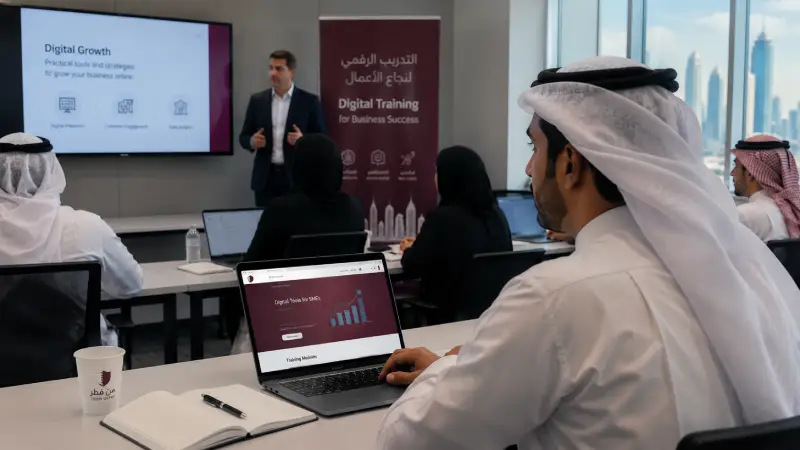
The program is built around a structured pathway rather than a one-time grant. It starts with a digital maturity assessment for each participating business, followed by a customised digital transformation roadmap. Throughout 2025 and into 2026, the program delivered specialised training sessions in partnership with Microsoft and Google Cloud, focused specifically on practical AI solutions and platform use, alongside sector-specific sessions run with the Ministry of Education, the Ministry of Public Health, and Qatar Tourism.
The results reported so far are concrete: participating SMEs have adopted 30 digital solutions across areas including customer relationship management (CRM), enterprise resource planning (ERP), and digital payment systems. The program has also run 94 matchmaking sessions connecting SMEs directly with 59 approved technology service providers, in partnership with Qatar Development Bank — meaning businesses aren't just getting training, they are being introduced to vetted vendors who can actually implement the tools.
Businesses interested in applying can find current details through MCIT's official website, and eligible SMEs are invited to apply directly through the ministry.
Where Small Businesses in Qatar Can Get Funding for AI Adoption
Beyond the SMEs Go Digital Program itself, Qatar Development Bank (QDB) offers financing products specifically aimed at digital transformation, which can be used to fund AI-related tools and systems.
Minha for Digital Transformation
This financing option is aimed at emerging and early-stage firms looking to begin their digital transformation journey. It is designed to lower the barrier for smaller or newer businesses that may not yet have the capital to invest heavily in technology upfront.
Technology and Digitalisation Solution Financing
This is aimed at more established SMEs looking to scale up their technology adoption — a better fit for a business that has already digitised the basics and wants to move into more advanced AI-driven systems, such as automated customer service or data-driven marketing tools.
QDB Advisory Services
Separately from financing, QDB also offers advisory services covering digital transformation more broadly, including ERP solution guidance and digital maturity assessments (such as SIRI assessments for manufacturers), helping business owners understand where they stand before committing to a specific technology investment.
| Program | Provider | What It Offers | Eligibility |
|---|---|---|---|
| SMEs Go Digital | MCIT | Digital maturity assessment, AI/digital training with Microsoft and Google Cloud, vendor matchmaking | Registered in Qatar, ≤250 employees, ≤QAR 100 million annual revenue |
| Minha for Digital Transformation | Qatar Development Bank | Financing for early-stage digital transformation projects | Emerging and early-stage Qatar businesses |
| Technology and Digitalisation Solution Financing | Qatar Development Bank | Financing for scaling up existing technology adoption | More established SMEs |
| QDB Advisory Services | Qatar Development Bank | Digital maturity assessments, ERP guidance (non-financing) | Qatar-based customers in QDB-mandated sectors |
A small business in Qatar does not need to self-fund AI adoption entirely. Between the SMEs Go Digital Program and QDB's financing products, there are real, structured pathways to get both training and capital support — the main task is figuring out which program fits your business size and stage.

Practical AI Use Cases for Small Businesses (Not Just Big Enterprise)
Much of the AI conversation in Qatar focuses on large-scale projects — smart grids, sovereign cloud platforms, AI in energy and logistics. Small businesses don't need any of that to benefit from AI. Here is where it realistically applies at a small business scale.
Customer Service — WhatsApp and Chatbot Automation
WhatsApp is the dominant communication channel for consumers across Qatar, and AI-powered automation on WhatsApp — automated responses to common questions, appointment booking, order status updates — can meaningfully reduce the time a small business owner or their staff spend on repetitive messages, without losing the personal responsiveness customers expect.
Marketing — Generative AI for Content and Personalised Campaigns
A 2025 Qatar Development Bank report specifically flagged generative AI as an area expected to grow significantly after 2026, with particular relevance to content creation and personalised marketing. This applies just as much to a service business as it does to retail — for example, our own local SEO playbook for cleaning companies in Qatar covers how AI-assisted content and review management can help a service business rank and convert, without needing a large marketing team.
Operations — Inventory, Scheduling, and Basic CRM/ERP Automation
The digital solutions already adopted through the SMEs Go Digital Program — CRM, ERP, digital payments — increasingly come with AI-assisted features built in, such as demand forecasting for inventory or automated follow-up sequences for customer relationship management. These are not flashy, but they are often where AI delivers the most consistent day-to-day value for a small operation.
Retail and Hospitality-Specific Applications
For retail and hospitality businesses specifically, practical AI applications include automated review response management, AI-assisted scheduling for staff and bookings, and personalised customer offers based on purchase history — all of which are achievable at small-business scale with existing, affordable tools rather than custom-built systems.
| Business Type | AI Use Case | Example Tool Category |
|---|---|---|
| Retail shop | Personalised offers based on purchase history | AI-enhanced CRM |
| Cleaning or home service company | Automated review response and WhatsApp booking | WhatsApp automation, chatbot tools |
| Real estate agency | AI-assisted property descriptions and lead follow-up | Generative AI content tools, CRM automation |
| Clinic or healthcare provider | Appointment scheduling and reminders | AI-assisted scheduling tools |
| Hospitality or restaurant | Social media content and review management | Generative AI marketing tools |

What to Watch Out For — Data Protection and Responsible Use
Qatar's PDPPL and What It Means When Using AI Tools With Customer Data
Any small business using AI tools that process customer data — even something as simple as a WhatsApp chatbot storing customer phone numbers and order history — needs to be aware of Qatar's Personal Data Privacy Protection Law (Law No. 13 of 2016), commonly referred to as PDPPL. It governs lawful processing, transparency, and purpose limitation for personal data. This is not a reason to avoid AI tools, but it is a reason to choose vendors and platforms that are transparent about how customer data is stored and used, rather than adopting the cheapest available tool without checking.
Avoiding Over-Investment Before Proving ROI on a Small Scale
One honest risk worth naming: AI vendors, understandably, want to sell comprehensive packages. For most small businesses, the more sensible approach is to start with one specific, measurable use case — for example, automating WhatsApp responses for the most common customer question — prove it works and saves real time, and only then expand into additional tools. This avoids the common pattern of paying for AI features that go unused because they were adopted before the business actually needed them.
How to Get Started — A Practical First Step Framework
Rather than treating AI adoption as one big decision, it helps to break it into a few grounded questions:
- Does your business meet the SMEs Go Digital Program's eligibility criteria (registered in Qatar, under 250 employees, under QAR 100 million revenue)? If yes, the digital maturity assessment is a logical, low-risk starting point.
- What is the single most time-consuming repetitive task in your business right now — customer messages, inventory tracking, appointment scheduling? Start your AI adoption there, not with the most advanced tool available.
- Have you checked whether QDB's Minha for Digital Transformation or Technology and Digitalisation Solution Financing applies to your business stage, rather than assuming you need to self-fund everything?
- Does the vendor or platform you are considering clearly explain how customer data is stored and used, in line with PDPPL requirements?
- Have you set a simple way to measure whether the tool is actually saving time or generating more enquiries, before expanding to additional AI tools?
| Business Stage | Recommended First Step | Program or Resource to Use |
|---|---|---|
| Just starting out digitally, no CRM/website in place | Build core digital foundation before adding AI | Website and WhatsApp setup, then SMEs Go Digital assessment |
| Have basic digital presence, want first AI tool | Automate one repetitive task (e.g. customer messages) | SMEs Go Digital Program, Minha for Digital Transformation |
| Already using CRM/ERP, ready to scale AI use | Add AI-driven marketing or forecasting features | Technology and Digitalisation Solution Financing |
Qatar's government support for AI adoption is genuinely substantial for a country of its size. The businesses that benefit most tend to be the ones that start with one clear, measurable use case rather than trying to adopt everything at once.
How NammoraX Can Help
AI adoption for a small business in Qatar usually starts with getting the basics right first — a website and customer communication system that AI tools can actually plug into. NammoraX has direct, verifiable experience building for the Qatar market, including a real estate website built specifically for Qatar's bilingual, WhatsApp-first buyer behaviour, a custom-built property marketplace platform for Imaz Classifieds in Doha, and social media and digital marketing work for a Doha-based food distribution business.
For small businesses in Qatar exploring AI adoption, this typically starts with a strong digital marketing foundation — a website and WhatsApp setup that can support automation — before layering on AI-driven customer service or personalised marketing tools. We help businesses figure out that sequencing, rather than jumping straight into tools that don't yet have the right foundation to plug into.
About NammoraX
NammoraX is a digital marketing and web design agency headquartered in Puttur, Dakshina Kannada, Karnataka, working with businesses across India and internationally, including Qatar. Our work in Qatar has included real estate website development, custom web application development, social media management, and local SEO for service businesses in Doha, giving us direct, verifiable experience with how businesses in this market actually reach their customers online.
Frequently Asked Questions
Is my small business in Qatar eligible for the SMEs Go Digital program?
Your business qualifies if it is registered in the State of Qatar, employs no more than 250 staff, and generates annual revenue not exceeding QAR 100 million. This covers most small and medium businesses in the country.
What funding is available for AI adoption for Qatar SMEs?
Qatar Development Bank offers "Minha for Digital Transformation" for emerging firms and "Technology and Digitalisation Solution Financing" for more established SMEs, alongside the training and vendor-matchmaking support available through the SMEs Go Digital Program.
What are the easiest AI tools for a small business to start with?
WhatsApp-based customer service automation is usually the most practical starting point for small businesses in Qatar, given how widely WhatsApp is already used for customer communication. Generative AI tools for marketing content are a close second.
Do I need to worry about data protection laws when using AI tools in Qatar?
Yes. Qatar's Personal Data Privacy Protection Law (PDPPL) applies to any AI tool that processes customer personal data, including simple chatbots that store phone numbers or order history. Choose vendors that are transparent about data handling.
Is generative AI actually useful for a small retail or service business?
Yes, particularly for marketing content and personalised customer communication. A 2025 QDB report specifically identified generative AI as a growing opportunity area for SMEs in content creation and personalised marketing.
How much does it cost a small business to start using AI in Qatar?
Costs vary widely depending on the tool and scale, but many small businesses start with low-cost or free-tier AI tools for a single use case (such as WhatsApp automation) before investing further, especially when combined with QDB's financing options for larger implementations.
Can a small business apply for QDB's digital transformation financing directly?
Yes, QDB's financing and advisory services are available directly to eligible Qatar-based businesses. It is worth confirming current eligibility criteria and application steps directly through QDB's official channels, since financing terms can be updated.
What's the difference between AI adoption and just "having a website"?
A website is the foundation; AI adoption is what you layer on top of it — automated customer responses, personalised marketing, data-driven operations. Without a solid website and communication system in place first, many AI tools have little to actually plug into.