Top 10 Shopify Stores in India in 2026 — and What Every Business Owner Can Learn From Them
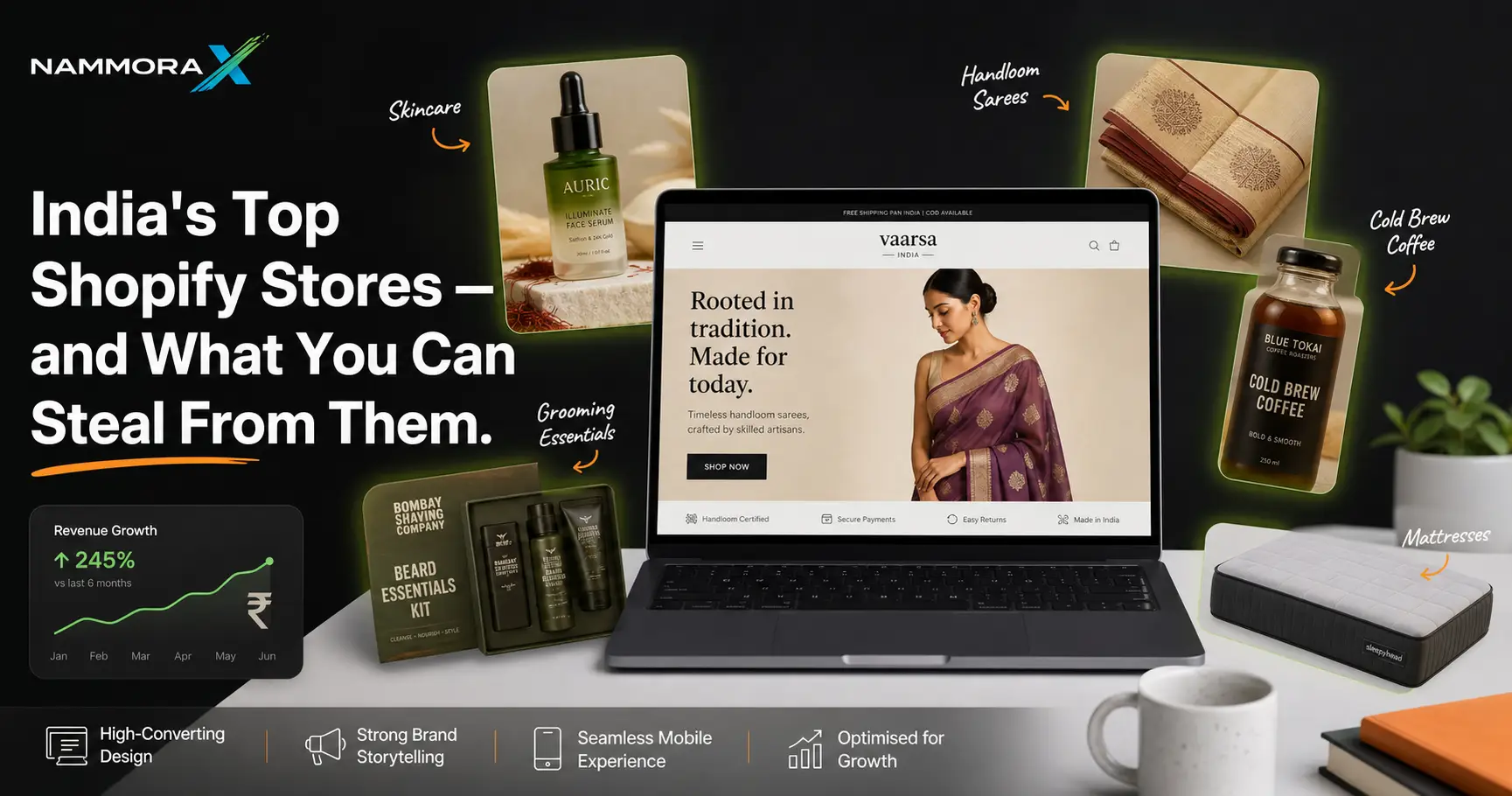
India's D2C e-commerce revolution is being built store by store — and the brands winning on Shopify are not winning because of the platform. They are winning because of specific, learnable decisions about brand storytelling, product positioning, customer experience, and digital marketing. This guide breaks down ten of India's most successful Shopify stores — Mamaearth, Sugar Cosmetics, Bombay Shaving Company, Suta, Minimalist, Sleepy Owl, Bombay Shirt Company, Vedix, Bummer, and Wakefit — with the exact lessons every Indian business owner can apply to their own store today, regardless of category or scale.
India's e-commerce market is one of the fastest-growing in the world — projected to cross USD 200 billion by 2027, driven by rising smartphone penetration, affordable data, digital payments through UPI, and a generation of consumers who are entirely comfortable buying online. At the centre of this growth is a new breed of Indian brand — the D2C, or Direct-to-Consumer company — that has bypassed traditional retail entirely and built its business by selling directly to customers through its own website.
And the platform powering a significant number of these brands? Shopify.
From skincare startups launched out of a Gurugram apartment to handloom fashion brands connecting artisans in rural India to customers in Singapore — Shopify has become the platform of choice for India's most ambitious e-commerce entrepreneurs. There are now over 1,20,000 active Shopify stores in India, with the highest concentrations in Maharashtra, Delhi, Gujarat, and Karnataka.
But here is the thing that makes these stores worth studying: the ones at the top are not succeeding because they picked the right platform. They are succeeding because of specific, learnable decisions about branding, storytelling, product positioning, customer experience, and digital marketing. This guide breaks down ten of India's most successful Shopify stores — what they do, what makes them exceptional, and the exact lessons you can apply to your own business whether you are selling online today or planning to.
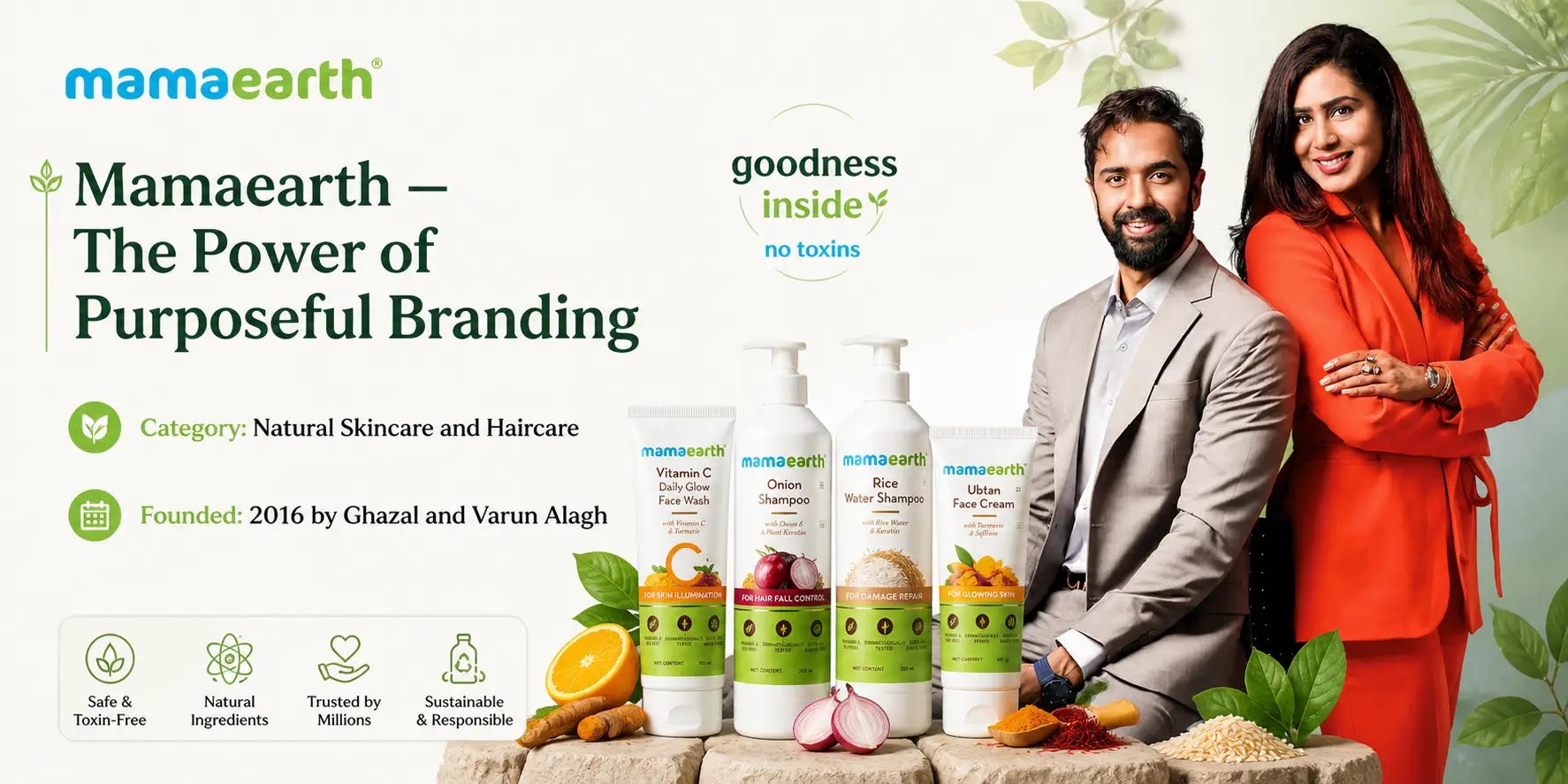
1. Mamaearth — The Power of Purposeful Branding
Category: Natural Skincare and Haircare
Founded: 2016 by Ghazal and Varun Alagh
What They Sell: Toxin-free, natural skincare, haircare, and baby care products
Mamaearth did not just build a skincare brand — it built a movement. Founded when Ghazal Alagh was searching for safe, chemical-free products for her newborn and could not find any, Mamaearth's origin story is not marketing copy. It is the actual reason the brand exists. That authenticity became the foundation of everything — the product formulation, the brand identity, the communication strategy, and the customer community.
Today, Mamaearth holds approximately 5.4% of India's online beauty and personal care market, has listed on the stock exchange, and generates revenue in the thousands of crores annually. Its Shopify store is a masterclass in clean design, benefit-led product pages, and community-driven social proof.
What You Can Learn From Mamaearth
- Your origin story is your most powerful marketing asset. Mamaearth grew to unicorn status not through TV ads but through authentic storytelling about why the brand was created. If your business was born out of a real problem you personally experienced, that story belongs front and centre on your website's homepage and About page.
- Purpose sells. "Toxin-free" and "Made Safe Certified" are not just claims — they are the entire brand promise. Customers who align with that purpose become loyal advocates, not just buyers.
- UGC is your most effective marketing content. Mamaearth's #GoodnessInside campaign went viral because real parents shared real experiences. User-generated content outperforms polished brand content for trust and conversion in the Indian market.
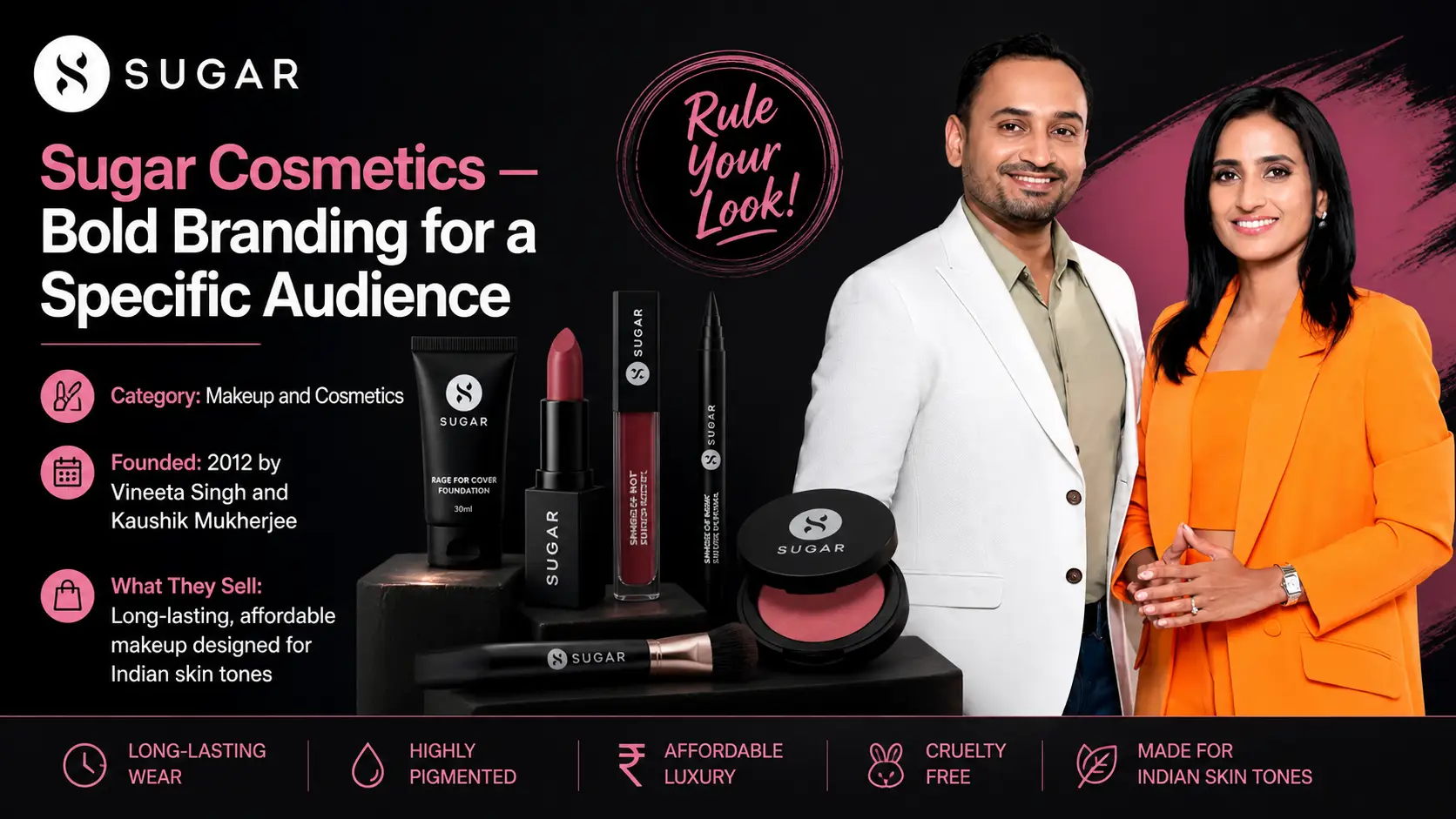
2. Sugar Cosmetics — Bold Branding for a Specific Audience
Category: Makeup and Cosmetics
Founded: 2012 by Vineeta Singh and Kaushik Mukherjee
What They Sell: Long-lasting, affordable makeup designed for Indian skin tones
Sugar Cosmetics identified a gap that the legacy beauty brands were ignoring: Indian women wanted bold, high-pigment, long-lasting makeup designed specifically for the Indian climate and Indian skin tones — not reformulated international products. Sugar built its entire brand around that insight. The result was a brand that felt unapologetically Indian, distinctively packaged, and social-media-native from day one.
Sugar recorded revenue of ₹505 crore in FY24 and operates across 45,000 retail points — but its Shopify store remains its brand home, driving discovery, storytelling, and direct sales with a consistently bold visual identity that extends from the packaging to every pixel on the website.
What You Can Learn From Sugar Cosmetics
- Design is your first conversion tool. Sugar's distinctive low-poly packaging and bold colour palette are instantly recognisable. Your product design and website visual identity are not decoration — they are the first things that tell a customer whether your brand is for them.
- Target specifically, not broadly. Sugar did not try to appeal to every Indian woman. It focused on millennials and Gen Z who wanted bold, expressive makeup — and owned that segment completely before expanding.
- Influencer marketing done right generates 40% of early sales. Sugar's aggressive early investment in influencer partnerships — particularly with beauty creators on YouTube and Instagram — is well documented as a primary driver of its initial growth surge.
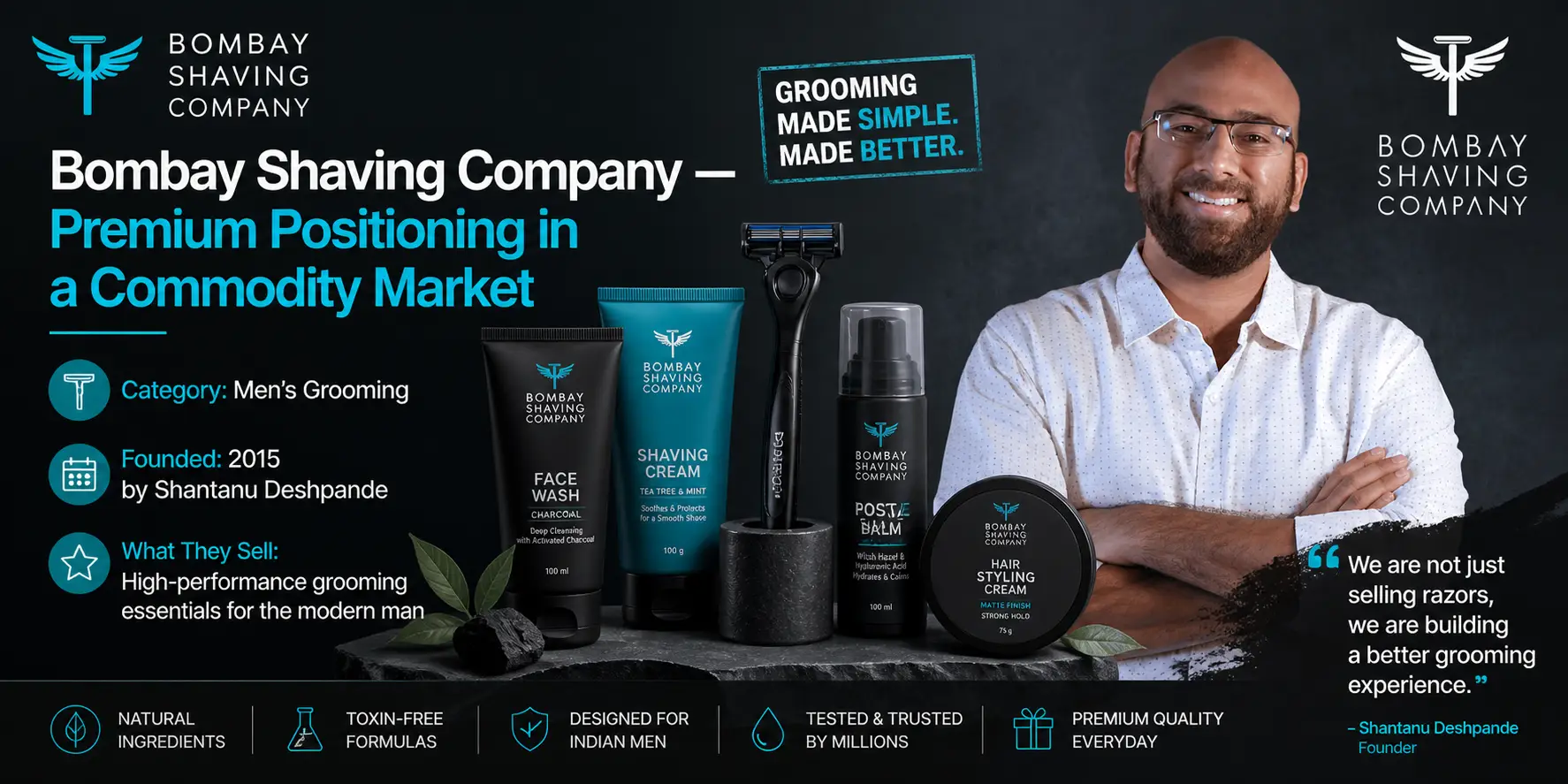
3. Bombay Shaving Company — Premium Positioning in a Commodity Market
Category: Men's Grooming
Founded: 2015 by Shantanu Deshpande
What They Sell: Premium shaving, skincare, haircare, and grooming products for men and women
Shaving is about as commoditised a product category as exists. Gillette had owned the Indian men's grooming market for decades. Bombay Shaving Company walked into this market and asked: what if shaving felt like a ritual instead of a chore? What if the experience of grooming was premium, curated, and actually enjoyable?
That positioning — premium, experience-led, with exceptional packaging and gifting options — differentiated Bombay Shaving Company entirely from both the mass brands and the pharmacy generics. It raised $52.7 million in funding, reached 2 million users, and built a Shopify store that treats every product page like a luxury editorial spread. The brand has since expanded into women's grooming and now offers over 200 products.
What You Can Learn From Bombay Shaving Company
- Premium positioning is available in any category. You do not need to invent a new product category to build a premium brand. Bombay Shaving Company redefined grooming — your business can redefine its category too.
- Gifting is an underutilised revenue channel. Bombay Shaving Company's beautifully packaged gift sets are a significant revenue driver, particularly during Diwali, Rakhi, Christmas, and Father's Day. If your product can be gifted, build gift-ready packaging and a gift collections section on your Shopify store.
- Product page storytelling drives conversion. Every product page on Bombay Shaving Company reads like an editorial feature — ingredients explained, benefits described, usage ritual outlined. Detailed, story-driven product pages convert significantly better than spec-list pages.
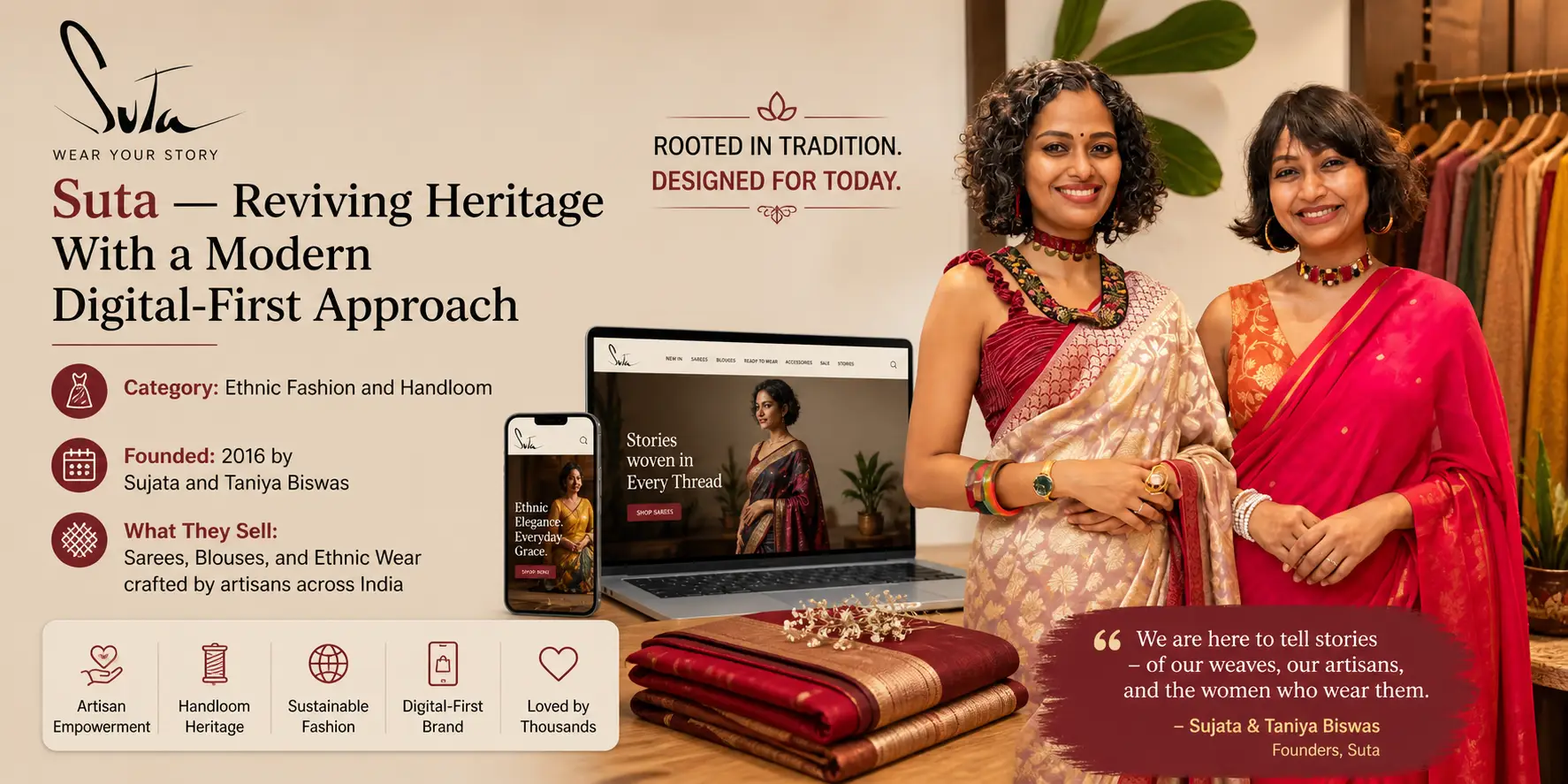
4. Suta — Reviving Heritage With a Modern Digital-First Approach
Category: Ethnic Fashion and Handloom
Founded: 2016 by Sujata and Taniya Biswas
What They Sell: Handcrafted sarees, blouses, and ethnic wear made with traditional Indian textiles
Suta is one of the most compelling stories in Indian D2C e-commerce. Two sisters — both former corporate professionals — quit their jobs to build a brand around handloom sarees made by Indian artisans. The brand's mission is as much about sustaining traditional craftsmanship and empowering weavers as it is about selling beautiful clothing.
Suta's Shopify store is exceptional for what it communicates without being loud about it. Every product tells a story — the weaver, the region, the textile tradition, the process. The result is a brand that customers feel genuinely connected to, and a product with a story that justifies a premium price far above commodity saree retail.
What You Can Learn From Suta
- The story behind your product is as valuable as the product itself. Suta does not just sell sarees — it sells the story of the artisan who made them, the tradition it represents, and the impact of the purchase. If there is a human story, a sustainability story, or a heritage story behind your product, make it central to your brand.
- Instagram is a full sales channel, not just a marketing channel. Suta built much of its early customer base entirely through Instagram, with a visual identity so consistent and beautiful that discovery, desire, and purchase all happen within the platform ecosystem.
- Niche is strength. Suta has not tried to be everything to everyone in fashion. It owns its specific niche — handcrafted Indian textiles — with exceptional depth. Owning a niche completely is more valuable than competing broadly in a crowded category.
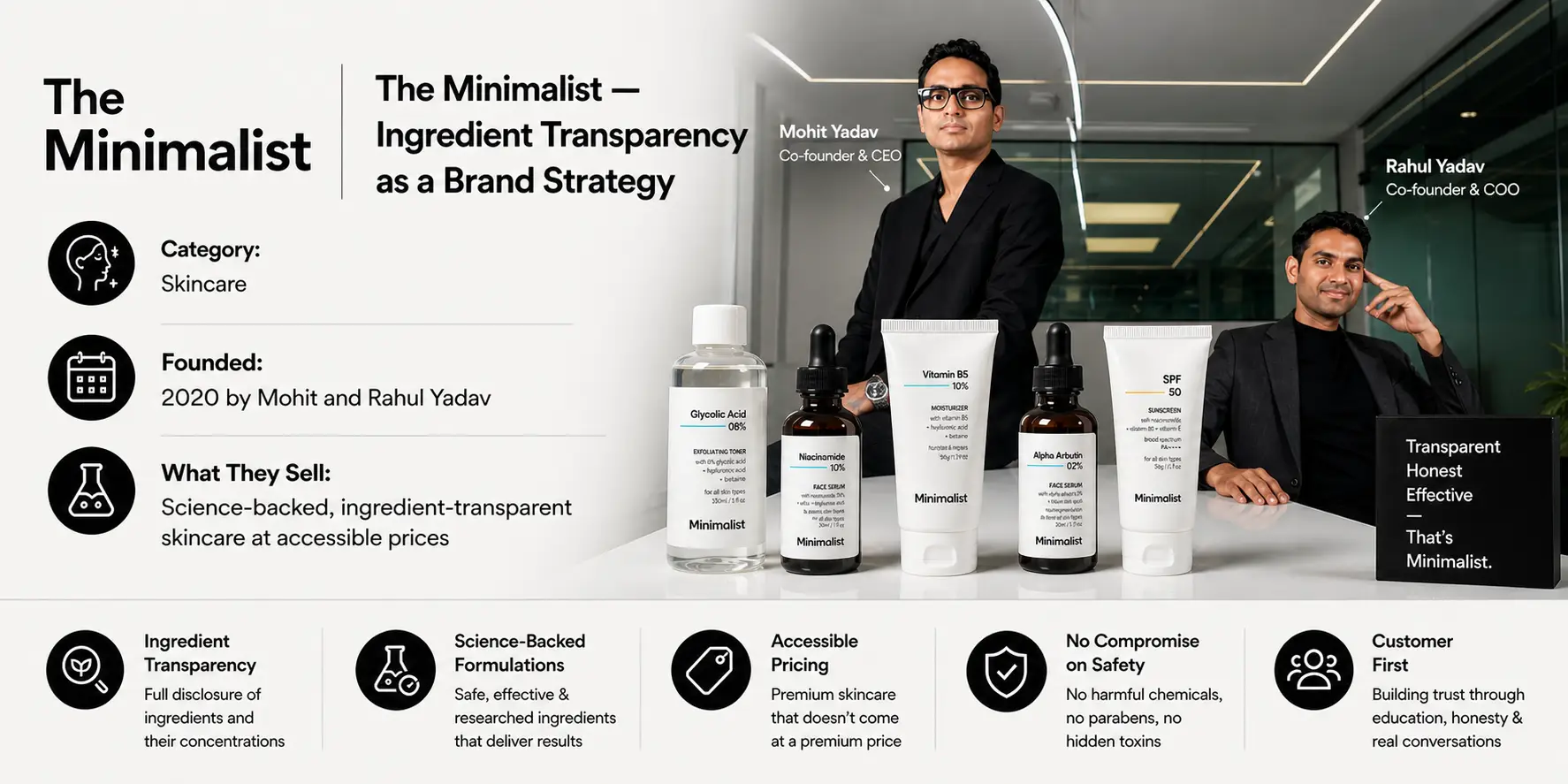
5. The Minimalist — Ingredient Transparency as a Brand Strategy
Category: Skincare
Founded: 2020 by Mohit and Rahul Yadav
What They Sell: Science-backed, ingredient-transparent skincare at accessible prices
Minimalist launched in 2020 and grew at a pace that shocked India's beauty industry. Its strategy was built on one core insight: Indian skincare consumers were becoming sophisticated. They were reading about ingredients — niacinamide, retinol, hyaluronic acid — and were frustrated that Indian brands either ignored ingredient science or packaged it in products priced out of reach.
Minimalist gave Indian consumers pharmaceutical-grade ingredients, honest formulations, and a complete absence of marketing fluff — at prices significantly lower than international equivalents. The brand was acquired by Hindustan Unilever for ₹2,955 crore in 2025, one of the largest D2C acquisitions in Indian history.
What You Can Learn From Minimalist
- Transparency is a competitive advantage. In a market full of vague claims and hero ingredients buried in formulations that barely work, radical transparency — showing exactly what is in your product and why — builds trust that no advertising budget can buy.
- Educate to convert. Minimalist's website, social media, and packaging are all heavily educational. Customers who understand what a product does and why it works are far more confident buyers — and far more loyal repeat customers.
- Accessible pricing unlocks scale. Premium quality does not always require premium pricing. Minimalist proved that you can build a mass-market brand with quality positioning by removing unnecessary marketing costs and passing those savings directly to the customer.
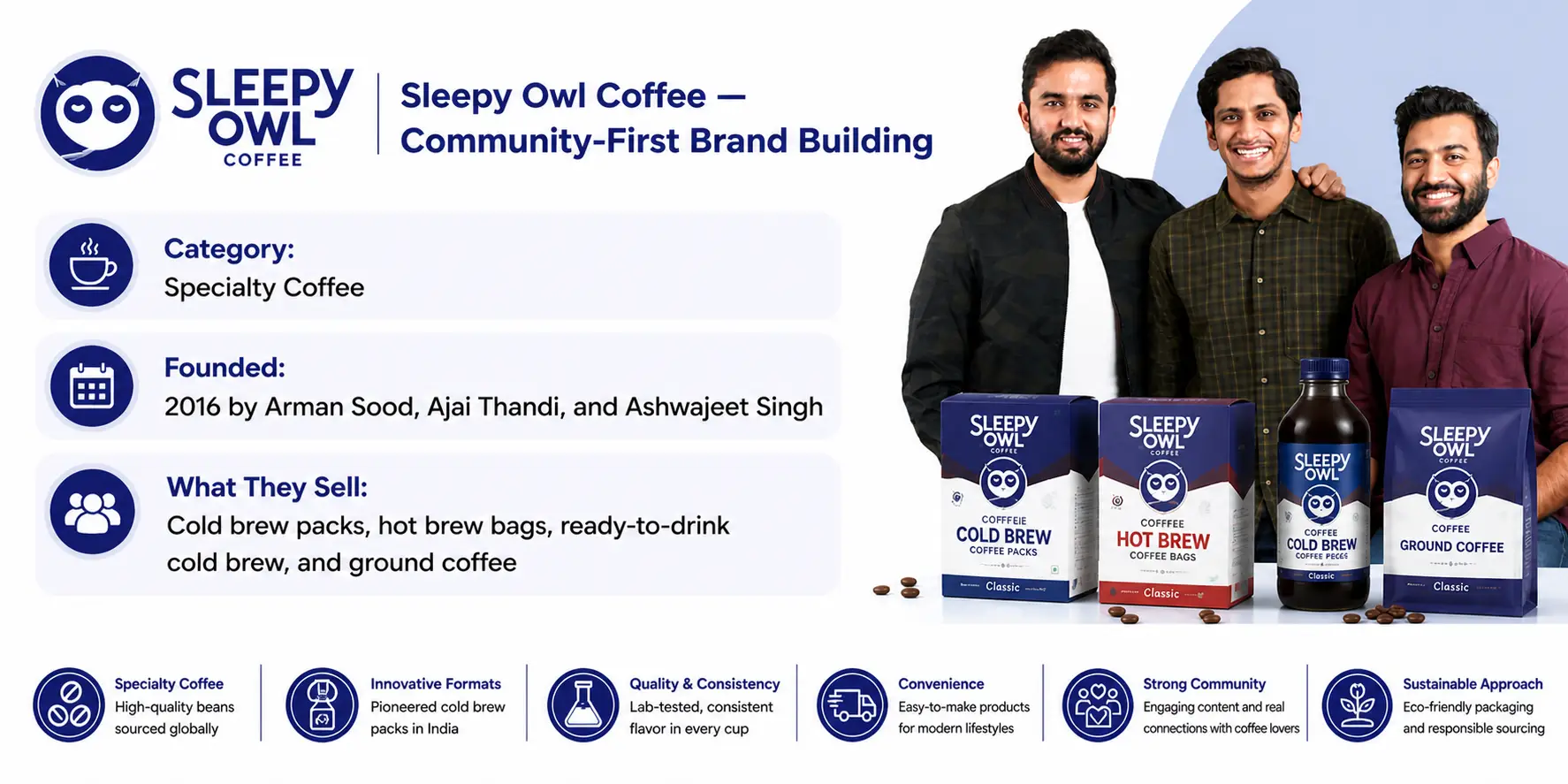
6. Sleepy Owl Coffee — Community-First Brand Building
Category: Specialty Coffee
Founded: 2016 by Arman Sood, Ajai Thandi, and Ashwajeet Singh
What They Sell: Cold brew packs, hot brew bags, ready-to-drink cold brew, and ground coffee
Sleepy Owl did not just sell coffee — it sold a coffee culture moment. Cold brew was niche in India in 2016. Most Indian consumers were either instant coffee drinkers or traditional filter coffee loyalists. Sleepy Owl patiently built a community of specialty coffee enthusiasts — through Instagram, through lifestyle influencers, through content that was about the ritual and experience of great coffee — before the mainstream caught up.
That community-first, content-first approach to brand building is precisely what tripled Sleepy Owl's growth in three years and built a brand loyalty that mass-market coffee brands with ten times the marketing budget struggle to replicate.
What You Can Learn From Sleepy Owl
- Build the community before the audience is ready. Sleepy Owl invested in building a specialty coffee community when cold brew was still niche. When the market caught up, Sleepy Owl was already the established authority. Invest in your community before the competition intensifies.
- Subscription models drive predictable revenue. Sleepy Owl's brew bag subscription — delivering fresh coffee at a set frequency — creates recurring revenue, reduces customer acquisition cost per order, and builds habitual loyalty that one-off purchases cannot.
- Lifestyle content sells better than product content. Sleepy Owl's best-performing content is not about coffee specifications — it is about the morning ritual, the work-from-home setup, the Saturday afternoon mood. Content that sells a lifestyle rather than a product consistently outperforms in the Indian digital market.
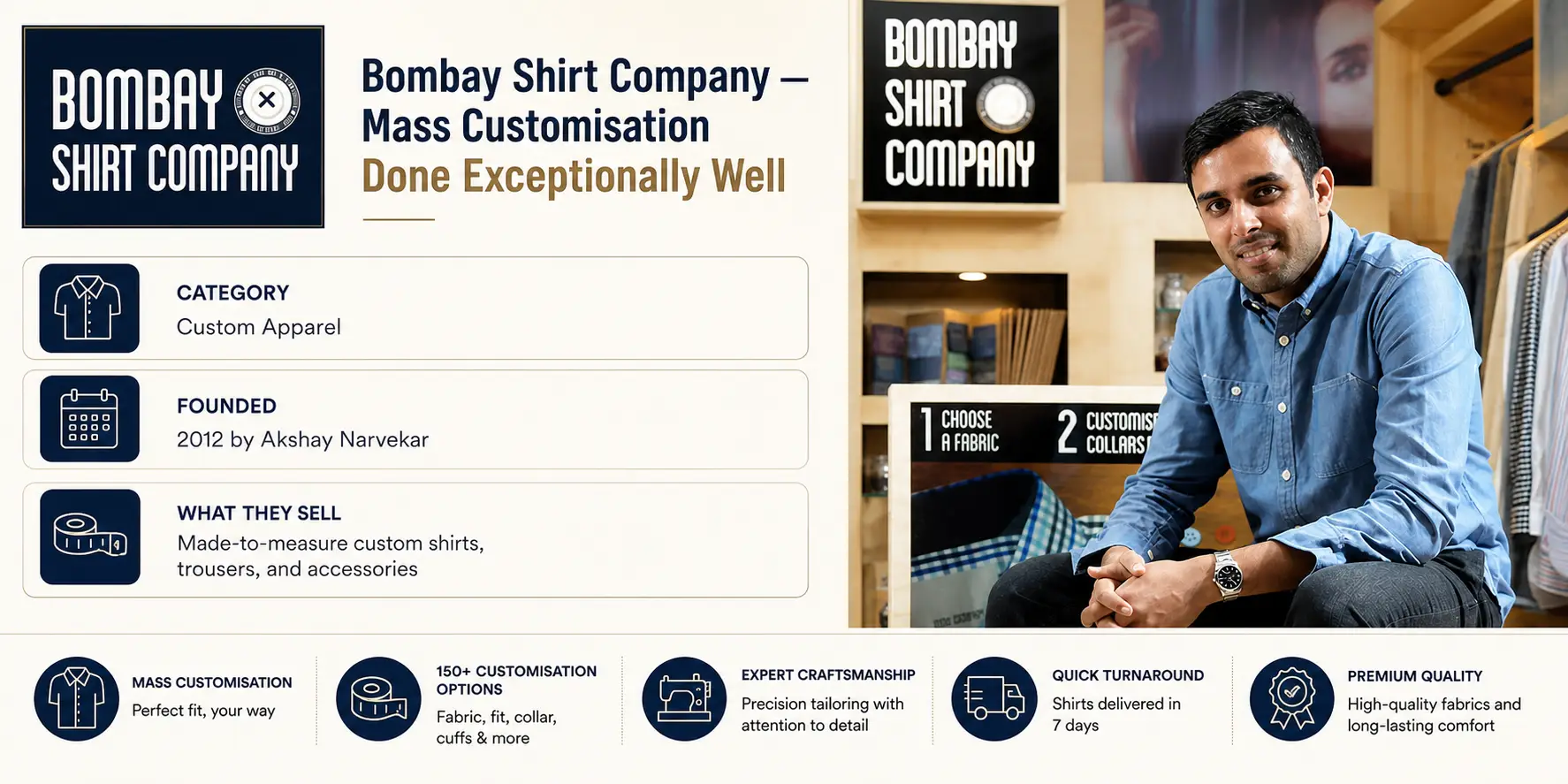
7. Bombay Shirt Company — Mass Customisation Done Exceptionally Well
Category: Custom Apparel
Founded: 2012 by Akshay Narvekar
What They Sell: Made-to-measure custom shirts, trousers, and accessories
Custom tailoring is deeply embedded in Indian culture — most Indian men have had something made by a local tailor at some point. Bombay Shirt Company took that cultural familiarity and rebuilt it for the digital-first, time-poor, quality-conscious urban professional. Online configurator, extensive fabric selection, precise sizing, delivered to your door in days. No tailor shop visits, no fitting appointments, no compromise on quality.
Bombay Shirt Company has offices in India, Dubai, and New York and has built a loyal customer base of professionals who now refuse to buy off-the-shelf shirts. Their Shopify store's UX — the fabric selection, the customisation journey, the sizing guide — is among the most thoughtfully built e-commerce experiences in India.
What You Can Learn From Bombay Shirt Company
- The online customisation experience is a product in itself. The way Bombay Shirt Company guides you through building your shirt — fabric, collar, cuff, monogram — is as much a part of the brand experience as the shirt itself. Invest in the buying experience, not just the product.
- Solve a real friction point better than anyone else. Custom tailoring had friction — time, inconsistency, the need for multiple visits. Bombay Shirt Company removed all of that friction. What friction exists in your customer's current buying experience that your brand can remove?
- International expansion is possible from day one with Shopify. Bombay Shirt Company serves customers in Dubai and New York from the same platform it uses in India. Multi-currency, multi-region selling is a significant competitive advantage for Indian brands with global potential.
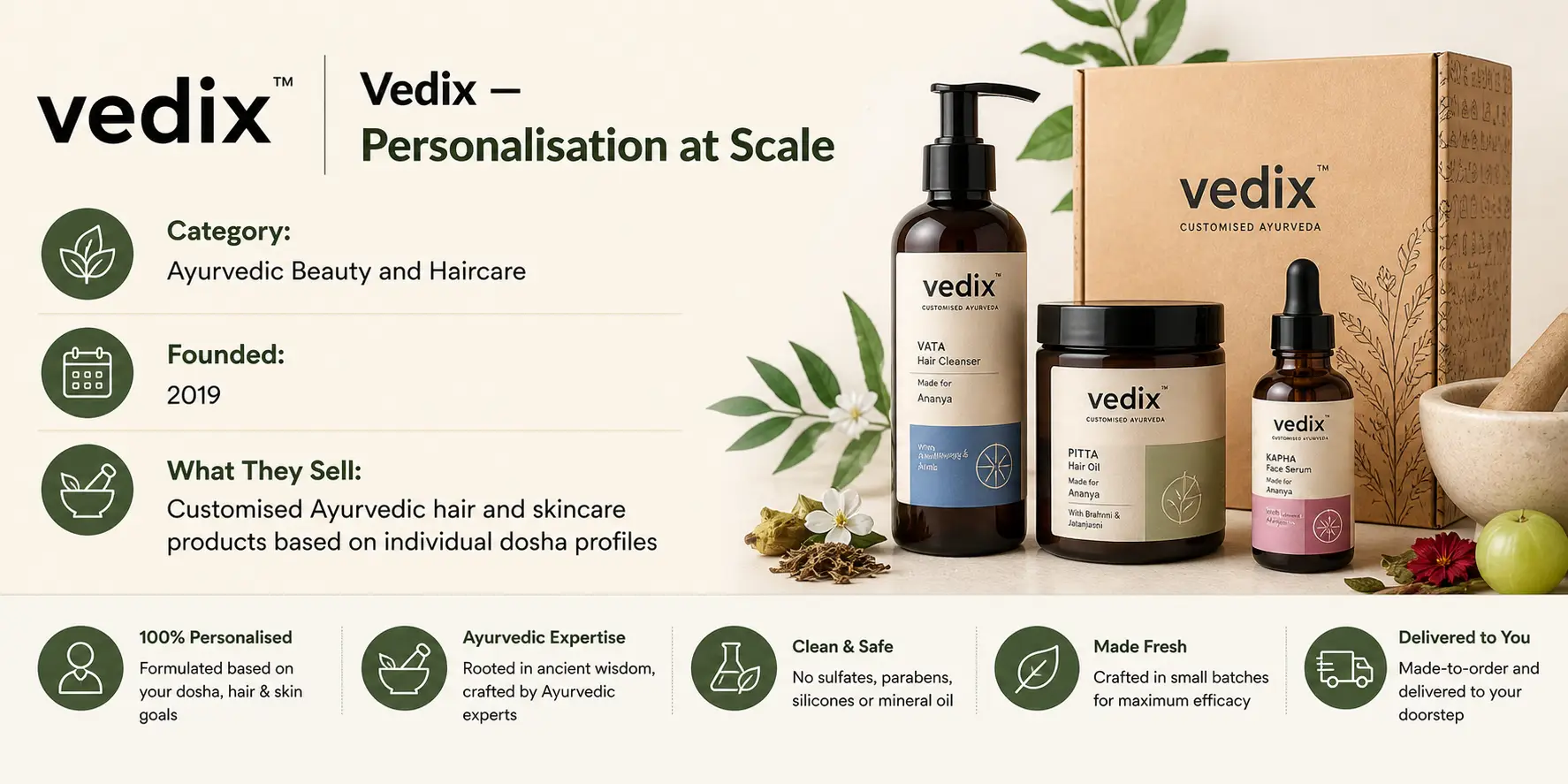
8. Vedix — Personalisation at Scale
Category: Ayurvedic Beauty and Haircare
Founded: 2019
What They Sell: Customised Ayurvedic hair and skincare products based on individual dosha profiles
Vedix is India's first fully personalised Ayurvedic beauty platform. Before a customer receives any product, they complete a detailed questionnaire about their hair type, scalp condition, lifestyle, diet, and Ayurvedic dosha profile. Vedix then formulates a custom product set — shampoo, conditioner, oil — specifically for that individual. Every customer's formulation is unique.
This personalisation-at-scale model is one of the most sophisticated e-commerce strategies in Indian D2C retail. It dramatically increases perceived product value, reduces price sensitivity, builds deep loyalty, and makes switching to a competitor genuinely difficult — because no competitor has your exact formulation.
What You Can Learn From Vedix
- Personalisation is the highest-value differentiation strategy available. When a customer feels a product was made specifically for them, price sensitivity drops and loyalty soars. Even light personalisation — a quiz that recommends the right product variant, a customised packaging message — measurably improves conversion and retention.
- Quizzes are powerful lead capture and conversion tools. Vedix's dosha quiz is both a lead generation mechanism and the core of the buying experience. Interactive product recommendation quizzes consistently improve e-commerce conversion rates by 30–50%.
- Subscription retention is easier with personalisation. When a product is customised for you, cancelling a subscription feels like losing something made exclusively for you — which dramatically reduces churn compared to generic subscription products.
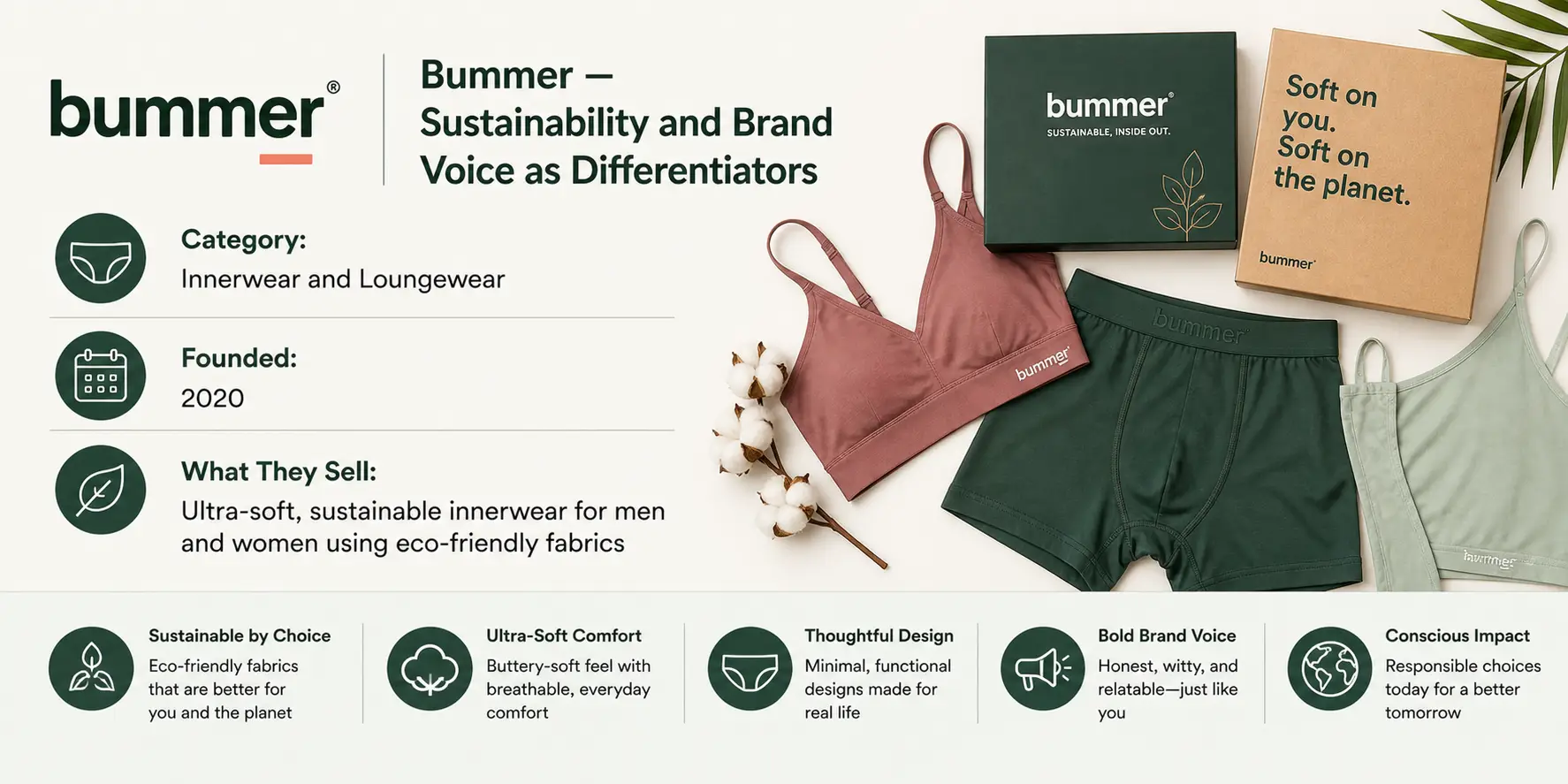
9. Bummer — Sustainability and Brand Voice as Differentiators
Category: Innerwear and Loungewear
Founded: 2020
What They Sell: Ultra-soft, sustainable innerwear for men and women using eco-friendly fabrics
Innerwear is perhaps the least glamorous product category in fashion — and Bummer has made it one of the most talked-about. By combining genuinely sustainable fabrics (Modal, Tencel, and organic cotton), exceptional softness, bold prints, and a brand voice that is irreverently funny and refreshingly honest, Bummer turned everyday basics into a brand people actively recommend to friends.
Bummer's Shopify store reflects the brand's personality throughout — the copy is witty, the product imagery is playful, and the sustainability credentials are front and centre without being preachy. It is a masterclass in how brand voice can differentiate a commodity product.
What You Can Learn From Bummer
- Brand voice is a competitive advantage that cannot be copied. Bummer's tone — witty, honest, direct — is as distinctive as their product design. A consistent, authentic brand voice across your website, social media, and packaging creates a recognisable personality that builds affinity far beyond what product quality alone can achieve.
- Sustainability is increasingly a purchase decision factor for Indian millennials and Gen Z. Bummer's commitment to eco-friendly fabrics is not just ethics — it is a business strategy. Indian consumers under 35 increasingly factor sustainability into their purchase decisions, and brands that lead with genuine sustainability credentials command both loyalty and premium pricing.
- Repeat purchase categories demand loyalty programme investment. Innerwear wears out and needs replacing — which makes it a naturally high repeat purchase category. Bummer's loyalty initiatives ensure that when a customer needs to restock, Bummer is the obvious and emotionally reinforced first choice.
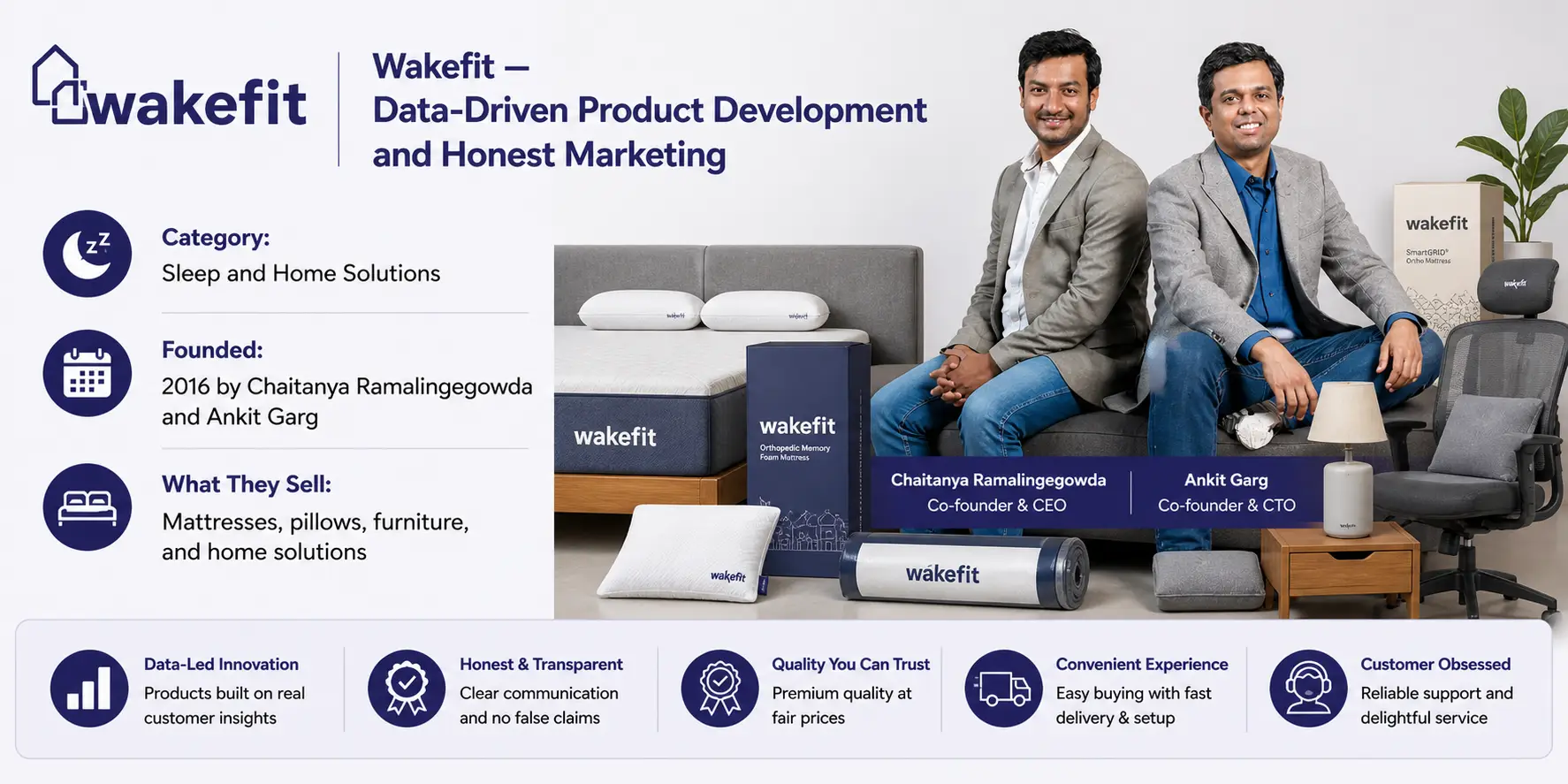
10. Wakefit — Data-Driven Product Development and Honest Marketing
Category: Sleep and Home Solutions
Founded: 2016 by Chaitanya Ramalingegowda and Ankit Garg
What They Sell: Mattresses, pillows, furniture, and home solutions
Wakefit entered one of India's most traditionally offline purchase categories — mattresses — and rebuilt the entire category for the digital age. It combined memory foam mattress innovation, direct-to-consumer pricing that removed retailer margins, viral humour-led content marketing, and a 100-night free trial that completely eliminated the buyer's primary objection: how do I know if I'll like sleeping on it?
Wakefit raised $105 million in funding, achieved a valuation of $275 million, and expanded from mattresses into a full home solutions brand. Its Shopify store is data-driven from the ground up — product development decisions, pricing, and marketing campaigns are all based on customer behaviour data collected through the direct sales channel.
What You Can Learn From Wakefit
- Remove the biggest purchase objection with a risk-reversal offer. Wakefit's 100-night trial removes the single biggest barrier to buying a mattress online — you cannot try it before you buy. A generous trial, return, or money-back policy is one of the most powerful conversion tools available to any online store selling considered purchases.
- The D2C model gives you data that traditional retail never could. Every customer interaction on your Shopify store — search behaviour, page time, cart additions, abandoned checkouts — is data that helps you make better product, pricing, and marketing decisions. Use it.
- Humour in marketing is a legitimate growth strategy. Wakefit's quirky, sleep-related content — their social media campaigns are consistently funny and shareable — built massive organic reach and brand recall that expensive paid campaigns cannot replicate. If your brand has room for personality, use it.
The 10 Key Lessons Every Indian E-Commerce Business Can Apply Today
Across all ten of these stores, certain patterns repeat consistently. These are not Shopify-specific tactics — they are fundamental principles of building a successful online brand in India.
- 1. Your origin story is your most underused marketing asset. Every brand on this list has a compelling founding story. If your business was born from a real problem or a genuine passion, tell that story on your homepage, your About page, and in your social content.
- 2. Niche depth beats broad reach. The strongest brands on this list own a specific niche completely — Suta in handloom, Minimalist in ingredient-led skincare, Sleepy Owl in specialty coffee. Owning a niche gives you brand authority that broad positioning never can.
- 3. Product page quality directly determines conversion rate. Every brand here invests heavily in product photography, copywriting, and storytelling at the product page level. A poor product page is the most common reason a well-trafficked Indian Shopify store fails to convert.
- 4. Mobile-first is non-negotiable. Over 80% of Indian online shoppers use mobile devices. Every store on this list loads fast, navigates intuitively, and checks out seamlessly on a smartphone. Test your Shopify store on three different Android devices today.
- 5. Risk reversal drives conversions for considered purchases. Generous return policies, free trials, and money-back guarantees remove hesitation at the point of purchase. In India's trust-sensitive e-commerce market, risk reversal is one of your most powerful conversion tools.
- 6. Subscriptions build predictable revenue and deep loyalty. Multiple brands on this list — Sleepy Owl, Vedix, Mamaearth — have subscription programmes that create recurring revenue and dramatically reduce customer acquisition cost per order over time.
- 7. Community is more durable than advertising. Every brand here has built a genuine community — not just a social media following. A brand community generates organic advocacy, UGC content, and repeat purchases that no advertising spend can replicate at the same cost.
- 8. Gifting and festival marketing are India-specific revenue accelerators. India's festival calendar — Diwali, Rakhi, Christmas, Eid, New Year — creates predictable demand spikes. Every successful Indian e-commerce brand builds specific gifting collections and runs dedicated festival campaigns that capture this recurring demand.
- 9. Influencer marketing with the right creators beats mass advertising. The brands on this list consistently used targeted influencer partnerships — often with micro-influencers rather than celebrities — as a primary customer acquisition channel. The key is alignment between the influencer's audience and your target customer, not raw follower count.
- 10. Data from your own store is your competitive advantage. Unlike selling on Amazon or Flipkart, selling on your own Shopify store gives you complete customer data — purchase history, browsing behaviour, search queries, return patterns. The brands here use that data to make better product, pricing, and marketing decisions continuously.
Frequently Asked Questions — Shopify Stores in India
Is Shopify good for Indian businesses in 2026?
Yes — Shopify is one of the strongest platforms for Indian D2C brands looking to sell directly to consumers and scale. It supports INR pricing, GST-enabled invoicing, integration with Indian payment gateways like Razorpay and PhonePe, and logistics partners like Shiprocket and Delhivery. Its app ecosystem is extensive, its themes are mobile-optimised, and it scales from a small business handling 50 orders a month to an enterprise brand handling tens of thousands. The platform's primary limitation for Indian brands is that its base plans are priced in USD — factor this into your cost planning.
How much does it cost to build a Shopify store in India?
Shopify subscription costs start at approximately $29/month (around ₹2,400/month) for the Basic plan, with higher tiers at $79/month (Shopify) and $299/month (Advanced) for growing businesses. In addition to the platform cost, budget for a domain name (₹800–₹1,500/year), a professional theme (free options available; premium themes cost $150–$350), app subscriptions for features like reviews, upselling, and email marketing (₹2,000–₹10,000/month depending on scale), and the one-time cost of designing and building the store (₹30,000–₹2,00,000 depending on customisation level and who builds it).
What is the difference between Shopify and selling on Amazon or Flipkart?
Selling on Amazon or Flipkart puts you in front of a large existing audience immediately — but at significant cost. Commission rates on Indian marketplaces typically range from 5% to 40% depending on category, you have limited control over the customer experience, you have zero customer data ownership, and you are competing directly with hundreds of other sellers including the platform's own private labels. Shopify gives you complete ownership of your store, your brand experience, your customer data, and your margins — but you are responsible for driving your own traffic through SEO, social media, and paid advertising. The most successful Indian D2C brands use both: Shopify as their brand home and primary margin channel, and marketplaces as supplementary distribution.
What products sell best on Shopify in India?
The top-performing categories on Shopify stores in India currently are apparel and fashion (38.7% of all Indian Shopify stores), home and garden products (13%), and beauty and fitness (11.3%). Beyond these, food and beverages, specialty coffee, Ayurvedic and wellness products, handcrafted and artisanal goods, custom products, and sustainable lifestyle brands consistently perform well. The common thread across successful categories is clear brand differentiation — it is rarely the product itself that drives Shopify success, but the brand story, quality positioning, and customer experience built around it.
How do the top Indian Shopify stores drive traffic?
The top Indian Shopify stores use a multi-channel traffic strategy: Instagram and Facebook organic content and paid advertising, influencer collaborations (particularly micro-influencers with highly engaged niche audiences), SEO for organic Google traffic, WhatsApp marketing for repeat customer engagement, email marketing for cart recovery and loyalty, and increasingly, collaborations with other complementary D2C brands for cross-audience exposure. The brands that grow fastest invest consistently in content — blog posts, Reels, YouTube — that builds organic reach over time and reduces ongoing dependence on paid advertising spend.
How NammoraX Can Help You Build and Grow Your Shopify Store in India
At NammoraX, we help Indian businesses and brands build Shopify stores that do more than just exist — they convert, retain, and grow. Whether you are launching a new D2C brand, migrating from another platform, or looking to improve the performance of an existing Shopify store, our team brings strategy, design, development, and digital marketing together to build your complete e-commerce growth system.
Here is what we deliver for Shopify businesses in India:
- Shopify store design and development — custom, mobile-first, conversion-optimised
- Product page copywriting and photography direction for maximum conversion
- Shopify SEO — product, collection, and blog page optimisation for Google organic traffic
- Payment gateway integration — Razorpay, PhonePe, UPI, and international options
- Logistics integration — Shiprocket, Delhivery, and other Indian fulfilment partners
- Instagram and Facebook content strategy and paid advertising for Shopify traffic and sales
- WhatsApp marketing setup for cart recovery, order updates, and customer retention
- Email marketing automation — welcome series, abandoned cart, post-purchase, loyalty
- Monthly performance reporting — traffic, conversion rate, revenue, and ROAS
Whether you are selling handloom sarees from Karnataka, specialty coffee from Coorg, natural skincare from Kerala, or custom fashion from Bengaluru — NammoraX will build the digital presence that takes your product from a great idea to a growing, profitable online brand.
👉 Talk to Us About Building Your Shopify Store | 📞 Call Us: +91 90 3629 4400
Disclaimer
This article is intended for educational and informational purposes only. The brands mentioned — including Mamaearth, Sugar Cosmetics, Bombay Shaving Company, Suta, Minimalist, Sleepy Owl, Bombay Shirt Company, Vedix, Bummer, and Wakefit — are independent companies with no affiliation to or endorsement of NammoraX. Revenue figures, funding data, and performance metrics referenced in this article are sourced from publicly available third-party reports and media coverage, and should be treated as approximate benchmarks rather than verified financial statements. All brand names, logos, and trademarks are the property of their respective owners.
About NammoraX
NammoraX is a full-service digital agency helping businesses across India and the Middle East build powerful, results-driven digital presences. From web design, branding, and social media marketing to SEO, paid advertising, e-commerce development, and content creation — we deliver end-to-end digital solutions built for real business growth. We work with D2C brands, startups, SMEs, and established businesses who want a digital partner that thinks strategically, executes excellently, and delivers measurable results.