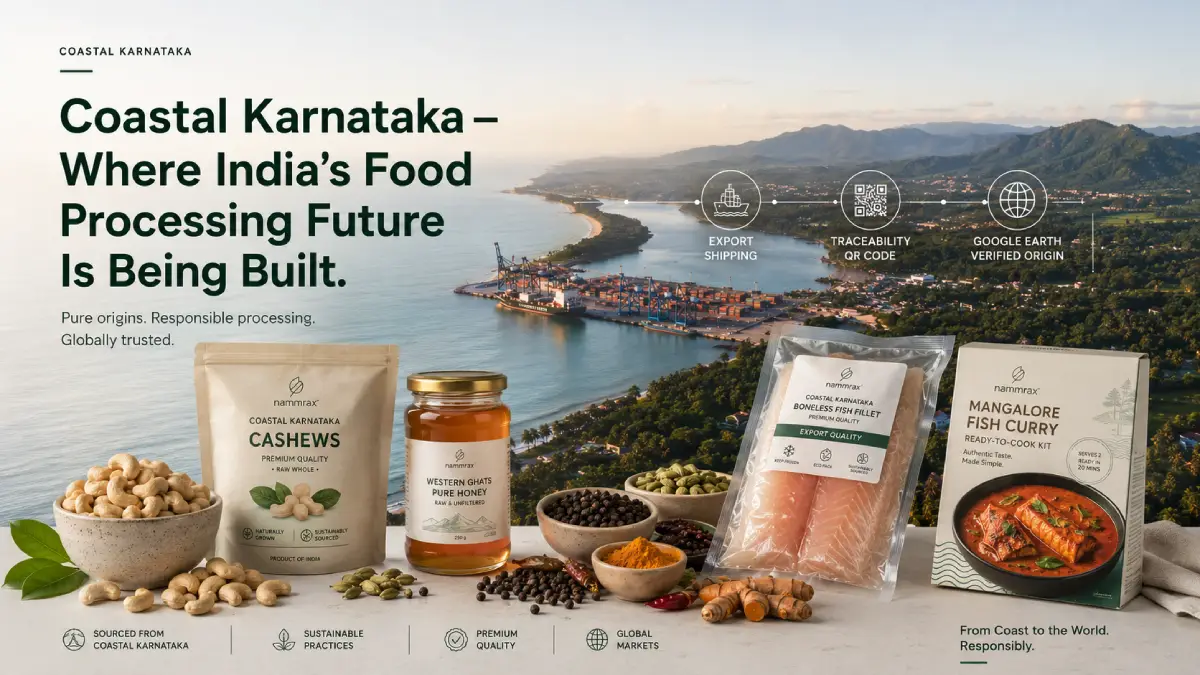
Why Food Processing Is Booming in Coastal Karnataka — And What It Means for Businesses in 2026
Coastal Karnataka has always fed the world — but in 2026, the scale, sophistication, and speed of transformation in this region's food processing sector is unlike anything seen before. India's food processing industry is projected to reach USD 535 billion in output, processed food now accounts for 20% of all agri-food exports, and coastal Karnataka sits at the centre of this national boom — with its 320-kilometre coastline, 25 GI-tagged agricultural products, New Mangalore Port infrastructure, and government schemes that have never been more generous. This guide covers the sectors leading the growth, the incentives available, the export opportunities, and how food processing businesses along this coast can build the digital presence to capture a global market that is actively looking for exactly what this region produces.
Coastal Karnataka has always fed the world. Long before modern supply chains and food safety certifications existed, the fishing communities of Ullal and Malpe were salting and drying fish for markets far beyond the coast. The cashew estates of Puttur and Sullia were shelling and processing nuts for export. The coconut groves of Udupi were pressing oil for kitchens across South India. The coffee estates of Coorg were roasting beans that ended up in cups in Mumbai, London, and New York.
What is different in 2026 is the scale, the sophistication, and the speed at which this region is formalising, upgrading, and expanding its food processing capacity — and the extraordinary national and global tailwinds making this the most opportune moment in a generation to build a food processing business along this coast.
India's food processing industry is entering a pivotal growth phase, with the sector projected to reach USD 535 billion in output by 2025–26, accounting for nearly 32% of the total food market and ranking among the top five globally. Processed food contributed 20% of India's agri-food exports in 2024–25. And coastal Karnataka — with its unique combination of marine resources, agricultural biodiversity, strategic port infrastructure, and a population deeply embedded in food culture and trade — sits at the centre of this national boom.
This guide explains why food processing is accelerating in coastal Karnataka, which specific sectors are leading the growth, what the government schemes and incentives look like, and how businesses across Mangaluru, Udupi, Dakshina Kannada, and the surrounding belt can position themselves to capture the opportunity.
The Natural Advantages That Make Coastal Karnataka a Food Processing Powerhouse
Before any policy or investment, coastal Karnataka's food processing boom is rooted in what the land, the sea, and the climate naturally produce. The region has raw material advantages that most of India's food processing hubs simply cannot replicate.
Marine Resources — A 320-Kilometre Coastline of Opportunity
Karnataka's coastline stretches 320 kilometres from Karwar in the north to the Kerala border in the south. The Arabian Sea off this coast is among India's most productive fishing grounds — yielding Pomfret, Kingfish, Mackerel, Sardines, Prawns, Squid, Cuttlefish, and a diversity of reef fish that supports both domestic consumption and export markets simultaneously.
India is one of the eight major fish-producing states in the country, and in FY25, India exported marine products worth USD 7.40 billion. Karnataka's share of this export volume — channelled primarily through the New Mangalore Port — is substantial and growing. The New Mangalore Port is India's seventh-largest container port and handles 75 percent of India's coffee exports and the bulk of its cashew nuts. The same port infrastructure that has made Mangaluru a cashew and coffee export hub is now increasingly serving the seafood processing and export industry.
Fish processing operations anchored in Ullal, Mangalore have established state-of-the-art processing plants producing premium Fish Meal, Fish Oil, and Fish Solubles — with capacities of 400 tonnes and expanding. This industrial-scale processing, previously concentrated in Gujarat and Andhra Pradesh, is increasingly finding its centre of gravity in coastal Karnataka's well-connected port district.
Agricultural Biodiversity — 25 GI-Tagged Products and Counting
Karnataka offers ample opportunities in the food processing sector, covering a wide range of products from fruits and vegetables to ready-to-eat and ready-to-cook items, highlighted by 25 food and allied Geographical Indicator (GI) tags. Many of these GI tags are specific to the coastal and Malnad belt — Coorg Arabica Coffee, Udupi Mattu Gulla brinjal, Navara rice, Coorg orange, Mangalore biscuits, Mysore Mallige jasmine — each representing a product with provenance-based premium pricing potential in both domestic and export markets.
The Western Ghats ecosystem backing this coastline produces a remarkable diversity of raw material for food processing:
- Cashew: Dakshina Kannada and Uttara Kannada together produce a significant share of Karnataka's cashew crop. Mangaluru is historically one of India's primary cashew processing hubs — with numerous processing units operating in and around the city for both domestic and export markets.
- Coconut: Coastal Karnataka is one of India's leading coconut-producing regions. Coconut oil, desiccated coconut, coconut milk, coconut flour, and coconut sugar all represent high-value processed products with strong domestic and international demand.
- Spices: Black pepper, cardamom, ginger, turmeric, and chillies from the Malnad belt surrounding the coast are raw materials for the spice processing and essential oil industry. Processed and packaged spices — especially those with GI certification and organic credentials — command significant premiums in export markets.
- Fruits: Mangoes from the Dakshina Kannada belt, jackfruit, pineapple, and the region's extraordinary banana diversity all support a growing processed fruit industry — mango pulp, jackfruit chips and ready-to-cook products, fruit-based beverages, and dried fruits for the health food market.
- Coffee: While Coorg is the centre, the coffee processing supply chain extends through Mangaluru — where the port handles 75% of India's coffee exports. Roasting, blending, packaging, and specialty coffee processing all represent opportunities for coastal Karnataka entrepreneurs.
💡 Regional Edge: Karnataka ranks as the largest producer of coffee in India, accounting for over 71% of the country's coffee production, and has 10 agro-climatic zones and 6 types of soil — making it an agricultural paradise. Coastal Karnataka sits at the processing and export interface of this extraordinary agricultural diversity — the natural gateway between Western Ghats production and global markets.
The Port Advantage — New Mangalore Port as an Export Accelerator
Geography is irreplaceable in food processing economics. Proximity to a major port reduces logistics costs, reduces transit time, and directly determines the viability of exporting perishable and semi-perishable processed food products. Coastal Karnataka has one of India's most significant port advantages for the food processing sector.
New Mangalore Port is India's seventh-largest container port and handles 75 percent of India's coffee exports and the bulk of the country's cashew nut exports. The port's existing cold storage infrastructure, its container handling capacity, and its direct shipping routes to the UAE, Gulf countries, Europe, and Southeast Asia make it an exceptional gateway for coastal Karnataka's processed food exporters.
The development of additional port and logistics infrastructure in the region — including the upgrade of Mangaluru's inland container depot and the improving road and rail connectivity to the port from the Malnad and Dakshina Kannada production zones — is further reducing the logistics friction for food processors in the region.
In northern and coastal Karnataka, districts including Uttara Kannada and the broader coastal belt can export spices, cashew, and horticultural produce with shorter inland transport distances and faster certification than processors relying on distant ports like JNPT. This logistics advantage directly translates into lower cost per export consignment and the ability to handle fresh and chilled products that would deteriorate on longer overland journeys to other ports.
The Sectors Leading Coastal Karnataka's Food Processing Boom
1. Seafood Processing and Export
Seafood processing is coastal Karnataka's largest and most globally integrated food processing sector. The combination of abundant marine raw material, port access, cold chain infrastructure, and an established network of MPEDA-registered exporters makes this the region's most mature food processing industry.
In FY26 (April to July 2025), India exported marine products worth USD 2.59 billion, up from USD 2.20 billion in the same period the previous year. India's seafood export industry is on a strong growth trajectory — and coastal Karnataka processors are well-positioned to capture an increasing share of this growth, particularly in the high-value frozen shrimp, value-added fish products, and processed cephalopod segments.
The opportunity in 2026 is not just in volume growth but in value addition. Frozen whole fish and raw shrimp have always been the base of Karnataka's seafood export — but the higher-margin opportunity is in Ready-to-Cook seafood products, marinated and seasoned fish fillets, shelf-stable fish curries, and packaged dry fish that capture the NRI market's demand for authentic Mangalorean seafood convenience products.
2. Cashew Processing
Coastal Karnataka has a multi-generational heritage in cashew processing. Mangaluru's cashew industry — once dominated by family-run processing units doing primarily raw nut processing — is transitioning into flavoured, branded, packaged cashew products for premium domestic and export markets.
The global demand for Indian cashews has strengthened significantly, with Europe, the USA, and the Middle East as major destination markets. Within the value chain, the premium opportunity lies in moving from bulk export of W180, W210, and W240 grades to branded, flavoured, portion-controlled consumer packs — Himalayan salt roasted, turmeric-spiced, dark chocolate-dipped — that command three to five times the per-kilogram price of commodity cashews in international retail channels.
3. Coconut-Based Products
Coconut processing in coastal Karnataka has historically been limited to cold-pressed coconut oil and copra. In 2026, the global demand for coconut-derived products — coconut milk, coconut cream, coconut flour, coconut sugar, MCT oil, desiccated coconut, and coconut water — has created an extraordinary opportunity for value-added processing in the region.
The health food and functional food market globally is driving strong demand for coconut-based products, particularly in the USA, Europe, and Australia. Karnataka-origin certified organic coconut products with GI provenance can command premium pricing in these markets that far exceeds the commodity value of raw coconuts or crude coconut oil.
4. Spice Processing
The Western Ghats and Malnad belt produce some of India's finest black pepper, cardamom, and ginger. The spice processing opportunity in coastal Karnataka is moving from basic cleaning and grading toward steam-sterilised, certified-organic, single-origin spice packs for export; essential oil and oleoresin extraction for food flavouring and pharmaceutical markets; and blended masala products targeting the global Indian diaspora's demand for authentic South Indian flavour profiles.
India's spice exports have been growing strongly, and Karnataka-specific GI-tagged spices — particularly Coorg cardamom and Coorg pepper — have premium positioning potential in specialty food markets globally.
5. Ready-to-Cook Mangalorean Cuisine
Perhaps the most exciting emerging opportunity in coastal Karnataka's food processing boom is the commercialisation and export of Mangalorean and Tulu cuisine — one of India's most distinctive, flavour-rich, and under-commercialised regional food cultures.
Mangalore Fish Curry paste, Neer Dosa ready-mix, Kori Rotti with Chicken Sukka curry pack, Devdas (raw mango curry) paste, Mangalore Buns mix, and Kane (Lady Fish) masala kits are all processed food products with genuinely differentiated flavour profiles that no multinational food company can replicate with authenticity. The NRI Tulu and Konkani community across the Gulf, the USA, the UK, Australia, and Singapore represents a highly motivated initial market for these products — and the general Indian food category in global specialty retail is growing rapidly.
The PMFME scheme (Prime Minister Formalisation of Micro Food Processing Enterprises) specifically supports micro-entrepreneurs entering this kind of artisanal regional food processing — making 2026 an opportune time to formalise and scale what was previously a cottage-scale or home-based food business.
6. Honey and Forest Products Processing
As detailed in earlier guides on Karnataka honey exports, the Western Ghats backing coastal Karnataka produces world-class monofloral and multifloral honey varieties — Coorg coffee blossom honey, eucalyptus honey, and wildflower forest honey — that have genuine premium positioning potential in the global organic honey market. Honey processing, packaging, and export from coastal Karnataka is a high-margin opportunity for entrepreneurs who invest in APEDA registration, organic certification, and premium branding.
Government Schemes and Incentives for Food Processors in Karnataka
The policy environment for food processing in India in 2026 is the most supportive it has ever been — and Karnataka's state-level incentive framework amplifies the national schemes with additional benefits for investors in the coastal and Malnad zones.
National Schemes
- PM Kisan SAMPADA Yojana (PMKSY): Under PMKSY, a total of around 1,607 to 1,618 food processing and preservation projects have been approved as of early 2026, of which about 1,185 have been completed and operationalised, benefiting over 51 lakh farmers across India. PMKSY provides capital subsidy grants for cold chain infrastructure, food processing units, and agro-processing cluster development. Coastal Karnataka businesses can apply through the Karnataka State Horticulture Mission.
- PLI Scheme for Food Processing: The Production Linked Incentive Scheme for food processing has been allocated Rs. 1,200 crore in the Union Budget 2026–27. PLI provides incentive payments based on incremental sales from a base year — supporting food processing companies that achieve minimum investment thresholds and demonstrate sales growth.
- PMFME Scheme: The Prime Minister Formalisation of Micro Food Processing Enterprises scheme has been allocated Rs. 1,700 crore in the Union Budget 2026–27. This scheme specifically supports micro-level food entrepreneurs with credit-linked capital subsidy, seed capital for SHG members, and capacity building — making it directly relevant for the small-scale food processors and cottage industry operators in coastal Karnataka.
- APEDA Registration and Market Development Assistance: Food processors and exporters registered with APEDA can access market development assistance for trade fair participation, buyer-seller meets, and product development — significantly reducing the cost of market entry for new exporters. Coastal Karnataka food exporters benefit from APEDA's strong focus on marine products, spices, and processed fruits and vegetables.
Karnataka State Incentives
- Karnataka Industrial Policy 2025–30: The policy provides preferential treatment for food processing investments in Zone 2 and Zone 3 districts — which include Dakshina Kannada, Udupi, and Uttara Kannada — with higher subsidy percentages, extended tax benefits, and priority single-window clearance.
- SEZ and Coastal SEZ at Mangaluru: The Government of Karnataka has sector-specific Special Economic Zones for food processing and agro-based industries, and an IT and Coastal SEZ at Mangalore. Food processors operating within these SEZs benefit from import duty exemptions, GST benefits, and simplified compliance.
- Food Parks: Karnataka has four state-sponsored and two MoFPI-sponsored Food Parks in six districts, providing pay-and-use common facilities for MSME food processing manufacturers. These shared infrastructure parks dramatically reduce the capital investment required for a new food processing unit by providing common processing equipment, cold storage, quality testing labs, and waste management facilities.
- NABARD and SIDBI Financing: Both NABARD and SIDBI offer preferential financing for food processing MSMEs in Karnataka — particularly for cold chain infrastructure, processing equipment, and working capital for export orders.
The Digital Gap — Why Coastal Karnataka's Food Processors Are Leaving Opportunities on the Table
The raw material advantages, the port infrastructure, the government incentives, and the global market demand are all converging in favour of coastal Karnataka's food processing sector. But there is a significant gap in how most food processors in this region are approaching their digital presence — and it is costing them buyers, contracts, and growth.
A food processor in Ullal with a 400-tonne capacity and MPEDA certification should be discoverable on Google by fish meal buyers in Japan, Norway, and China searching for Indian suppliers. They should have a professional website with product specifications, lab certifications, and an export enquiry form. They should appear on IndiaMART, on Alibaba, and in APEDA's Agri Exchange portal. They should have a LinkedIn company page that their management team uses to connect with international buyers and distributors.
Most do not have any of these. A cashew processing unit in Puttur with decades of experience, consistent quality, and APEDA registration is invisible to a Whole Foods supplier in California or a premium snack brand in the UAE because their digital presence does not exist or does not communicate their capabilities effectively to international buyers.
The food processors winning export contracts in coastal Karnataka in 2026 are the ones that have invested in three things: quality certifications, a professional digital presence, and active buyer outreach through digital channels. The businesses that have all three are capturing business from international markets. The businesses that have only the first — and most of them do — are waiting for buyers to find them through brokers and trade shows while competitors with weaker raw material advantages but stronger digital presence win the contracts.
How Digital Marketing Supports Food Processing Business Growth in Coastal Karnataka
Whether you are a seafood exporter in Mangaluru, a cashew processor in Puttur, a honey producer in Coorg, or a ready-to-cook brand building a Mangalorean cuisine product line — your digital presence is your sales infrastructure for the global and domestic market.
Export-Facing Website
Your website is the first thing an international buyer checks after receiving your introduction email or finding you on a B2B platform. It must communicate your product range, your certifications, your quality standards, your processing capacity, and your export experience in a way that builds immediate confidence. A professional export-facing website with downloadable product specifications, lab report summaries, and a clear trade enquiry form is the minimum digital infrastructure every coastal Karnataka food processor needs.
SEO for International Buyer Discovery
SEO for food processors targets the search queries international buyers use when looking for Indian suppliers — "frozen fish meal supplier India," "certified organic cashew exporter Karnataka," "ready-to-cook Indian seafood export," "GI-tagged Karnataka spices wholesale." A well-optimised website and IndiaMART profile can generate inbound buyer enquiries from international markets at zero per-click cost — one of the most efficient lead generation channels available to food exporters.
Content Marketing for Authority Building
Content marketing — origin story articles, product documentation, quality process explainers, and market guides — positions coastal Karnataka food businesses as knowledgeable, credible, and premium suppliers. International buyers researching Indian food suppliers will read your content and form their first impression of your company's professionalism and expertise before they ever contact you.
Social Media and LinkedIn for B2B Buyer Outreach
LinkedIn is the primary platform for B2B food industry connections — importers, distributors, retail buyers, and food service procurement managers from the USA, Europe, UAE, and Australia are active LinkedIn users. Social media management that includes regular LinkedIn posts about your products, certifications, and production process builds the brand visibility that converts into buyer conversations.
WhatsApp for Trade Communication
Across Gulf and Asian markets, WhatsApp is the standard channel for initial trade enquiries and ongoing business communication. A WhatsApp Business account with a complete company profile, product catalogue, and professional auto-responses makes your business immediately accessible to buyers who prefer this channel — which in the UAE, Qatar, Singapore, and Sri Lanka markets, is most of them.
Frequently Asked Questions — Food Processing in Coastal Karnataka
What are the most profitable food processing opportunities in coastal Karnataka in 2026?
Based on current market demand, export growth trends, and raw material availability, the highest-margin opportunities are: value-added seafood products for export (Ready-to-Cook, marinated fillets, shelf-stable curry products); certified organic single-origin honey from the Western Ghats; premium branded cashew products for the health food segment; coconut-derived products (MCT oil, coconut flour, coconut sugar) for the international health food market; and authentic Mangalorean ready-to-cook cuisine products targeting the global NRI market. All of these benefit from GI provenance, organic certification potential, and the port access advantage of the Mangaluru coastal belt.
What licences and registrations does a food processor in coastal Karnataka need?
At minimum: FSSAI Central Licence (for businesses above ₹12 lakh turnover or with export intent), GST registration, and shop and establishment registration. For export: Import Export Code (IEC) from DGFT, APEDA registration (for scheduled agricultural products), and MPEDA registration (for marine products). For organic products: NPOP certification and USDA NOP or EU Organic certification depending on target markets. For value-added products: specific labelling compliance with FSSAI's Packaging and Labelling Regulations. The process is streamlined through Karnataka's Single Window System at investkarnataka.co.in.
How much investment is needed to start a small food processing unit in coastal Karnataka?
This varies widely by category. A micro food processing unit — a spice cleaning and packaging operation, a cashew processing unit, or a honey processing and packing facility — can be established for ₹10 to ₹30 lakhs at the micro scale. A mid-size seafood processing unit with freezing and cold storage infrastructure requires ₹1 to ₹5 crores. The PMFME scheme provides credit-linked capital subsidy of up to ₹10 lakhs for micro units — reducing the equity requirement significantly. Karnataka's Food Parks provide shared infrastructure that can reduce the capital requirement for new processors by 40 to 60 percent.
Is the NRI market a viable initial export target for coastal Karnataka food businesses?
Yes — and in many ways it is the ideal initial export market for coastal Karnataka food products. The NRI Tulu, Konkani, and Kannada community across the Gulf, the USA, the UK, and Australia has a strong, emotionally motivated demand for authentic products from their home region. They are willing to pay premium prices for quality, authenticity, and regional provenance. They are reachable through highly targeted digital advertising on Facebook and Instagram. And they are often the first customers who validate product-market fit before a wider market rollout. For a Ready-to-Cook Mangalorean cuisine brand or a coastal Karnataka honey export business, the NRI community in the UAE and Qatar is both the most accessible initial export market and the most receptive.
How does NammoraX help food processing businesses in coastal Karnataka grow their digital presence?
NammoraX builds the complete digital infrastructure that food processors and agri-food exporters in coastal Karnataka need to find buyers, build credibility, and convert enquiries into contracts. This includes export-facing website design, SEO for international buyer discovery, content marketing for authority building, B2B platform profile optimisation (IndiaMART, Alibaba, APEDA Agri Exchange), LinkedIn strategy for buyer outreach, and WhatsApp Business setup for trade communication. Visit our locations page or contact us directly to discuss your specific business needs.
How NammoraX Helps Food Processing Businesses in Coastal Karnataka Grow
At NammoraX, we work with food processors, agri-food exporters, and food entrepreneurs across coastal Karnataka, Mangaluru, Puttur, and Dakshina Kannada — building the digital presence and marketing systems that connect their quality products with domestic and international buyers.
We understand the food processing landscape in this region — the GI-tagged products, the export certification requirements, the NRI buyer opportunity, and the digital channels through which international food industry buyers actually discover and evaluate new suppliers. We build digital strategies that are grounded in how this industry and this market actually work.
Here is what we deliver for food processing and agri-food businesses:
- Export-facing website design — professional, mobile-optimised, with product catalogues, certification document downloads, and international trade enquiry forms
- International SEO — optimised for buyer-intent search terms in the USA, EU, UAE, and other target markets
- Brand identity and packaging design — premium label design that competes on international retail and trade shelves
- Content marketing — origin stories, product documentation, blog content and buyer guides that build credibility and attract inbound enquiries
- Social media strategy — LinkedIn for B2B buyer discovery, Instagram for D2C brand building, YouTube for origin and process storytelling
- Google and Meta Ads — campaigns reaching food importers, distributors, and NRI buyer communities in your target markets
- WhatsApp Business integration — for responsive trade enquiry communication and NRI customer engagement
- E-commerce setup — for direct-to-consumer domestic and international sales through your own branded online store
- Full digital marketing programmes — for food brands ready to scale across multiple channels simultaneously
Whether you are a seafood processor in Ullal building an export brand, a cashew entrepreneur in Puttur moving up the value chain, a honey producer in Coorg targeting the global organic market, or a food entrepreneur building a Ready-to-Cook Mangalorean cuisine brand — NammoraX will build the digital presence that puts your products in front of the right buyers, in the right markets, at the right moment.
👉 Talk to Us About Growing Your Food Processing Business | 📞 Call Us: +91 90 3629 4400
About NammoraX
NammoraX is a full-service digital agency helping businesses across coastal Karnataka, India, and the Middle East build powerful, results-driven digital presences. From web design and brand identity to SEO, digital marketing, content marketing, and e-commerce — we deliver end-to-end digital solutions built for real business growth. We work with food processors, exporters, real estate developers, retailers, and service businesses who want a digital partner that understands their market and delivers measurable results. Visit our locations page to find out how we serve clients across the region.